Commercial lighting specifications in the Middle East now go far beyond watts and lumens. UAE and Saudi projects may require different control evidence, glare calculations, shop drawings, and conformity documents.
This 2026 guide shows contractors, consultants, lighting designers, and project buyers what to verify before approval. It covers DALI-2, UGR, continuous linear runs, customization, BOM control, and Saber documentation.
Start with the trend table. Then download the project specification checklist before you issue an RFQ.
2026 Middle East Commercial Lighting Trends: What to Specify
| Trend | What Is Changing | Specification Check |
|---|---|---|
| Energy controls | Efficacy alone no longer satisfies project briefs | Verify zoning, scheduling, and DALI-2 device compatibility |
| Glare control | UGR labels are room-dependent, not fixture-only | Confirm DIALux calculation in actual project geometry |
| Continuous linear | Custom lengths and junctions drive buildability | Lock remainder sections, feed positions, and L/T joints on drawing |
| Direct/indirect | Ceiling reflectance changes up-light performance | Specify up/down ratio against actual ceiling color |
| Customization | More projects require non-standard housing or finish | Record every custom item against drawing, sample, and BOM |
| Submittal quality | Generic brochures slow consultant approval | Submit model-specific datasheet, IES/LDT, CAD, and certificates |
| Modular maintenance | Driver access affects downtime during occupancy | Verify tool-less access, spare-part availability, and warranty terms |
| Compliance split | UAE and Saudi follow different approval routes | Confirm country, emirate, authority, and product-specific requirements |
| Supplier qualification | Sample approval must translate to repeatable production | Ask 10 qualification questions before sign-off |
| Technical review | BOQ and RCP review reduces site surprises | Send complete project package for engineering review before RFQ |
Light + Intelligent Building Middle East reported 16,473 trade visitors and 340 exhibitors from 30 countries at its 2026 edition. The attendance does not prove that every project adopts the same technology, but it shows how strongly lighting, building controls, and technical specification now overlap across the region.
How Should Middle East Projects Specify Energy-Efficient Lighting Controls?
Efficacy is only the first layer of energy-efficient commercial LED lighting. Operation is the second.
Two 140 lm/W luminaires can still use energy differently. One runs at full output for 14 hours. The other dims near windows, switches off in empty rooms, and follows separate zone schedules.
In Dubai offices, a typical floor may combine perimeter daylight zones, core occupancy zones, and circulation areas that run on separate time schedules. Specifying one uniform control group wastes the energy-saving potential of the fixture.
Verify three items before approval. First, confirm the DALI-2 device list matches the control system manufacturer’s compatibility matrix. Second, check that each zone has a clear sensor type and setpoint. Third, require a control narrative that identifies which fixtures dim, which switch, and which hold a constant output.
Does a UGR Label Guarantee Low Glare?
A UGR label does not guarantee low glare in every room. The result depends on room dimensions, surface reflectance, mounting height, luminaire spacing, viewing direction, and optical distribution.
A “UGR<19” linear light may support the target under stated conditions. Change the room or layout, and the result can change with it. Verify UGR in the project geometry, not on the product label alone.
In an open-plan office with dark workstations and a low ceiling, the same linear fixture can produce a higher UGR than the datasheet suggests. The reverse is also true: a pale ceiling and wider spacing can improve the result beyond the rated value.
Require a DIALux or Relux calculation for each distinct room type. The calculation should use the actual ceiling, wall, and floor reflectance, the confirmed mounting height, and the final layout. Treat the fixture UGR rating as a starting point, not as proof of compliance.

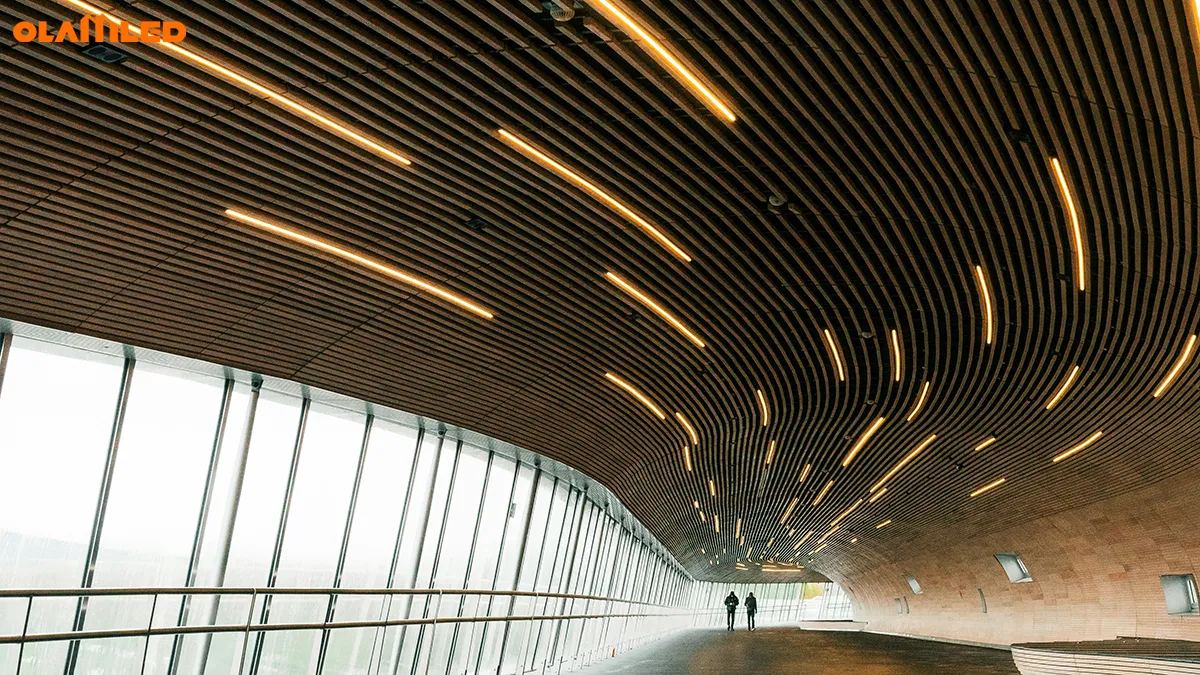
What Makes a Continuous Linear Run Buildable?
Picture a 17.4-metre office run that does not divide into standard luminaire lengths. Leave the remainder until production, and a short section may land beside the wall.
Unplanned driver loads and feed positions can also create extra ceiling access points. L- and T-junctions add three more checks: the visible corner, optical continuity, and electrical path.
Before approving a continuous linear layout, confirm four details on the drawing. First, mark the exact length of every section, including the non-standard remainder. Second, identify each feed position and the driver load it carries. Third, specify how L- and T-junctions maintain optical continuity at the corner. Fourth, confirm the ceiling access required for driver replacement after installation.
A buildable linear run is designed on the drawing, not solved on site.
When Does Direct/Indirect Lighting Improve the Space?
Direct/indirect fixtures distribute light upward and downward in a controlled ratio. The upward component relies on the ceiling to reflect light back into the room, so ceiling color and reflectance directly affect the result.
A dark ceiling absorbs up-light and reduces the effective ambient contribution. A pale ceiling reflects more light and can lower the required down-light output. In Middle East projects, ceiling finishes vary from white gypsum to exposed concrete and black sprayed soffits, so the same up/down ratio does not perform equally across spaces.
Specify the up/down ratio against the actual ceiling reflectance. For white or pale ceilings, a 60/40 or 70/30 up/down split often works well. For darker ceilings, reduce the upward component or switch to a direct-only configuration. Require a photometric calculation that includes the ceiling reflectance so the approved ratio matches the real space.
Which Custom Lighting Details Must Be Locked?
Lock each custom choice to a drawing, sample, or BOM record:
- Dimensions: overall length, housing size, and connection structure
- Light quality: CCT, CRI, beam angle, and glare-control optic
- Finish: RAL color or an approved physical reference
- Electrical: driver, dimming method, and control protocol
- Installation: mounting hardware, suspension points, and junction details
A hotel may need a project-specific bronze finish. An office may need a 1,350 mm section that aligns with ceiling modules. A retailer may need CRI 90 optics and black reflectors for accurate merchandise color.
Every custom item must appear in three places: the approved drawing, the signed sample, and the BOM. If one of these records is missing or inconsistent, production can deliver a fixture that matches neither the consultant’s approval nor the site requirement.

Which Documents Should a Lighting Submittal Include?
A consultant cannot approve a configuration that the submittal does not identify. Include:
- the model-specific datasheet;
- the matching IES or LDT file;
- the project DIALux calculation, where required;
- a dimensioned CAD and installation drawing;
- the named driver and control components;
- relevant test reports and certificates; and
- a clear revision history.
A generic brochure is not enough. If one datasheet lists three wattages and four optics, mark the exact offered combination.
For example, a 40 W datasheet with a 30 W driver option creates confusion if the submittal does not identify which combination is being offered. The reviewer cannot tell which luminous efficacy, which power factor, or which photometric file applies. Mark the exact configuration on every document, and keep the revision history current through each approval cycle.
Build a cleaner lighting RFQ before you contact suppliers. Download the free Middle East Commercial Lighting Project Specification Checklist to capture fixture, control, drawing, and document requirements in one place.
Free download. No account needed. Takes about 3 minutes to complete.
How Does Modular Design Reduce Maintenance Disruption?
A driver failure in an occupied commercial space does more than replace a component. It requires ceiling access, technician time, and often a partial shutdown of the lighting zone. Modular design reduces that disruption by making the driver and key components accessible without removing the entire fixture.
When evaluating a modular fixture, verify three items. First, confirm the driver can be replaced without tools or with a standard tool, and without lowering the luminaire body. Second, check that spare drivers are available for the full warranty period and that the replacement part matches the original electrical specification. Third, confirm that a driver replacement does not require recalibration of the control system or re-addressing of DALI devices.
A fixture that is easy to maintain costs less over the project lifecycle, even if the initial purchase price is slightly higher.
Do UAE and Saudi Projects Follow the Same Approval Route?
No. A single “Middle East lighting compliance” claim is too broad for project approval. Requirements can change by country, emirate, authority, client, consultant, application, and exact product configuration.

In the UAE, Dubai’s Al Sa’fat rating and Abu Dhabi’s Estidama Pearl requirements can influence lighting power density and control specifications. Individual emirates and free zones may apply additional approval procedures. In Saudi Arabia, the Saber platform requires product conformity assessment for regulated categories, and the specific documentation depends on the product type and the issuing certification body.
Before approving a supplier, confirm five items: the target country, the specific emirate or city, the approving authority, the product category under that authority, and the exact model configuration. Do not accept a general “Middle East compliant” statement as proof of approval for any specific project.
📥 Free Download: Middle East Commercial Lighting Project Specification Checklist
Planning a project in UAE or Saudi Arabia? Get our one-page engineering checklist covering DALI-2 compatibility, SABER/SASO compliance, and UGR calculation verification to avoid costly delays.
10 Questions to Ask a Commercial Lighting Supplier Before Approval
Ask these 10 questions before you approve a submittal, sample, or production reference. Record every answer against the exact model and revision.
- Can you provide the model-specific datasheet for the exact wattage, optic, and driver configuration being offered?
- Is the IES or LDT photometric file matched to this exact configuration, and can you share it for our DIALux calculation?
- What is the rated luminous efficacy at the confirmed driver current and operating temperature?
- Which control protocol is supported (0-10V, DALI, DALI-2), and is the device listed on the control system manufacturer’s compatibility matrix?
- What is the UGR value under the specific room geometry we have provided, and can you supply the calculation file?
- Which custom items (length, finish, CCT, CRI, optic) are locked to the approved drawing and sample, and how are they tracked in your BOM?
- What is the lead time for production samples and for mass production, and how do custom items affect that lead time?
- What is the warranty period, which components are covered, and what is the spare-part availability horizon for drivers, LED modules, and diffusers?
- Which compliance documents can you provide for the target country and authority (UAE/Saudi), and is the product registered under the exact model number?
- What is your process for locking the approved golden sample into production, and how do you verify that production units match the approved reference?
What Should You Send for a Technical Lighting Review?
A specification-led project needs a repeatable path from brief to production. OLAMLED reviews the project requirements, prepares the drawing and sample, locks the approved reference, and carries that record into production and quality control.
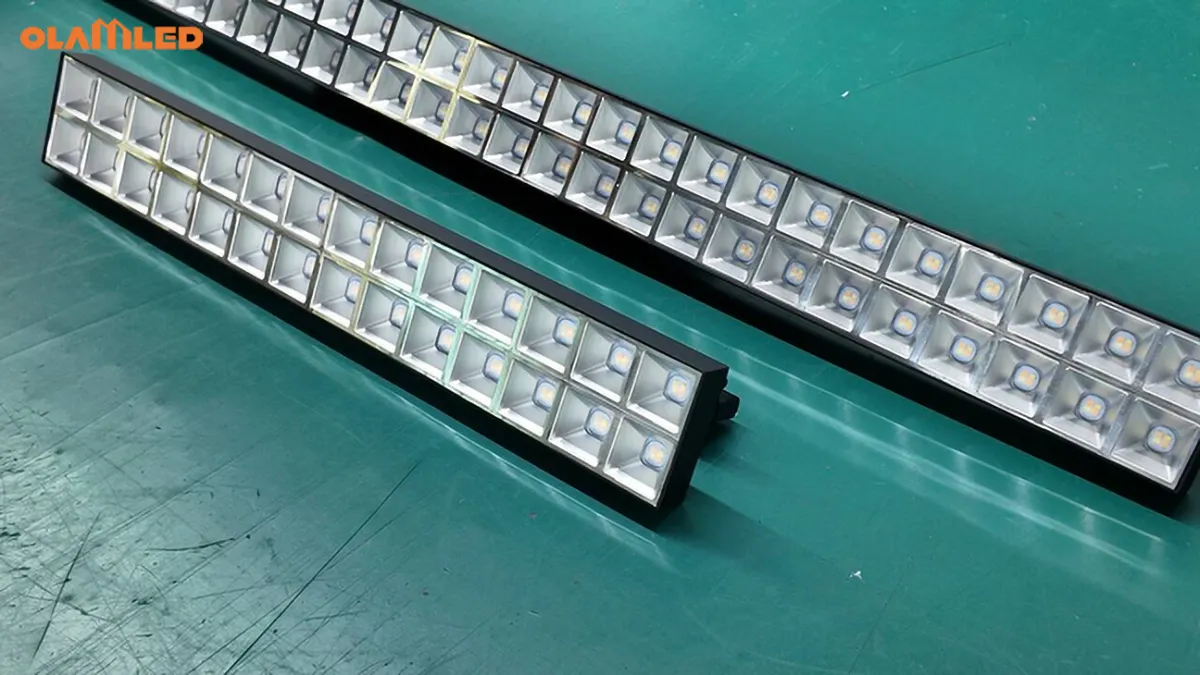
Available product families include linear lights, modular panels, grille lights, track linear lights, and track panel lights. Choose the family after the project requirements are clear, not before.
For a technical review, send the BOQ with target quantities, the RCP or ceiling layout, the control narrative, the required UGR or lux level, the compliance target country, and any custom finish or dimension requirements. The review returns a product recommendation, a drawing set, a sample plan, and a production timeline that matches the project schedule.

Before you send the BOQ, make the specification review-ready. Download the free Middle East Commercial Lighting Project Specification Checklist and use it to verify the model, optics, controls, drawings, documents, and approval route.
Free download. One checklist. A clearer RFQ for every supplier.