DALI-2 LED panel dimming is the control of a commercial ceiling LED panel over a certified two-wire digital bus (IEC 62386), where the driver is the certified product and every panel gets its own address, group and scene. It is the German commercial project default. TRIAC, 1–10 V and Casambi are different control paths for different buildings, and none of them is a substitute for it.
An RFQ that only says “dimmable” is how a TRIAC driver lands on a DALI floor, and how the panel arrives dead on handover day.
The working answer: DALI-2 is the German commercial project default for addressable panels. TRIAC/phase-cut is a residential/small-retrofit driver, not an office bus. 1–10 V is analogue simple zones. Casambi is the wireless renovation path when you will not pull DALI pairs. “DALI” on a carton is not proof; check the DALI Alliance product database for the driver.
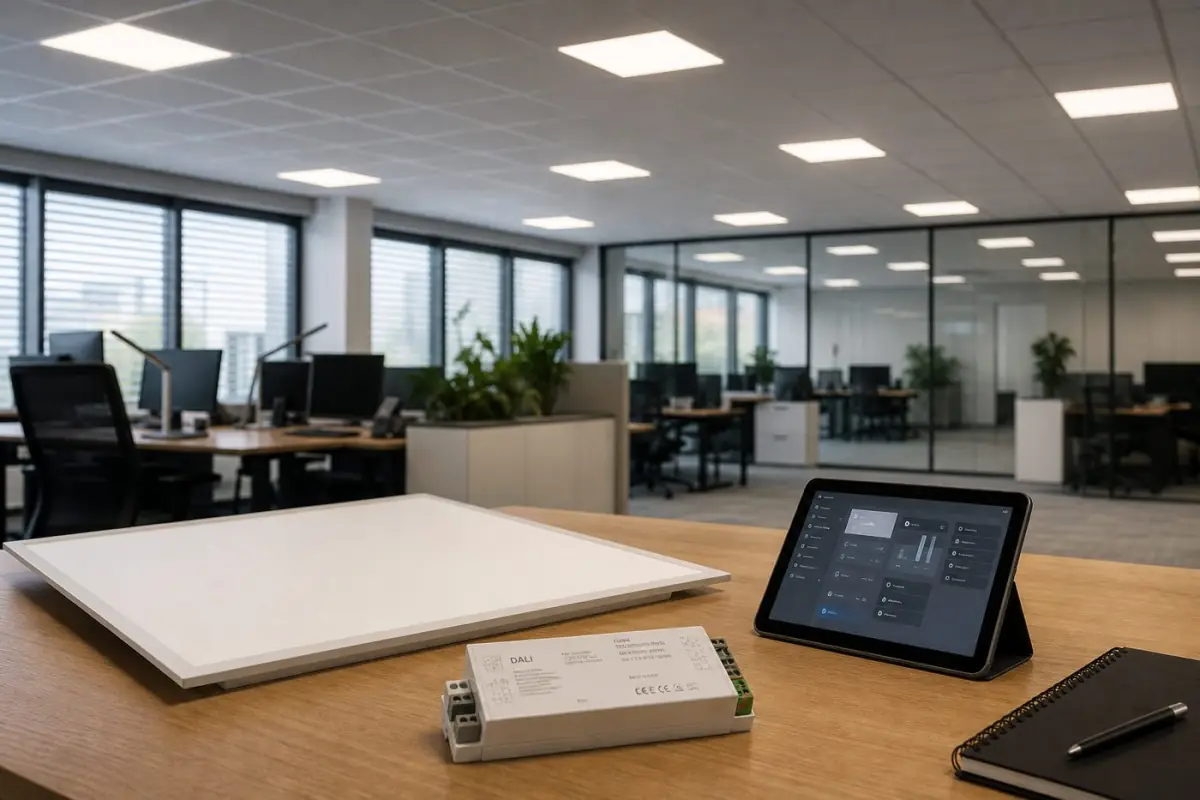
Below: what DALI-2 certification actually proves, a six-protocol matrix, the Pst LM / SVM values to demand at 10–30 % scenes, DT6 vs DT8, and a copy-paste RFQ spec line.
Written by the OLAMLED engineering team, a Shenzhen custom commercial LED OEM/ODM factory with 17 years in commercial LED, supplying brand owners, distributors and project specifiers in Germany and the EU. This page covers ceiling commercial LED panel lights only (recessed, surface or pendant Rasterleuchte replacements), not video, photo or therapy LED panels.
This article is one cluster node of the LED Panel Light Buying Guide for Germany: Size, UGR & Commercial Specs. It goes deep on one decision: which control protocol to write on a German/EU commercial LED panel RFQ, and how to prove the driver. Grid cut is a separate node, 620×620 mm for Odenwald / Rasterdecke versus ~595×595 mm for 600 mm T-bar, and UGR class lives in the pillar’s glare section. Wrong glare class or wrong millimeters will not be fixed by the bus. So what does the DALI-2 logo on a carton actually prove?
What DALI-2 certification actually means (vs a “DALI” sticker)
DALI-2 is DiiA’s independently verified certification program. Test specifications come from IEC 62386 (the international DALI standard) or from extra DiiA specs. A member tests the product; DiiA verifies the results before the DALI-2 wordmark or logo may be used.

DALI version-1 is self-declaration. The member tests and registers, with no verification step. DiiA says that model produced interoperability issues. New version-1 registration is closed. Version-1 gear can still appear in the database; it is not DALI-2 certified and is marked not recommended for new designs.
DiiA does not issue test reports or paper certificates. Every DALI-2 certified product is listed in the Product Database. If it is not listed, it is not DALI-2 certified. The same rule applies to version-1 registration.
Two OEM-RFQ catches:
- Luminaires are not listed. Search the driver: brand, model, DALI Product ID, GTIN. A carton logo does not replace that row.
- The row must match the hardware. Brand, GTIN, firmware and hardware versions have to match, plus a valid ID unique with that GTIN. A relabel or firmware fork is not the certified SKU.
“DALI-2 compatible” on a datasheet is marketing English. The RFQ language is: DALI-2 certified, listed at dali-alliance.org/products, brand and model stated. Which protocol should that line name for your building?
Protocol matrix: On/Off, TRIAC, 1–10 V, DALI-2, D4i, Casambi
Mix a wall dimmer, an analogue pair and a digital bus on one floor plate and your panels arrive “dead”, flicker, or refuse to join the BMS. German commercial ceilings run 220–240 V. The protocol you write is a driver choice, not an LED-board choice.

| Protocol | Signal | Typical DE commercial use | Strength | Watch-outs | What to write on the RFQ |
|---|---|---|---|---|---|
| On/Off | Mains switched | Storerooms, archive, back-of-house | Lowest cost; no commissioning | No scenes, no harvesting, no addressing | On/Off driver, not dimmable |
| TRIAC / phase-cut | Leading- or trailing-edge on mains | Residential and small retrofit with an existing wall dimmer | Reuses the dimmer already on the wall | Not a German office bus. Flicker if the driver is not phase-cut rated | Do not write TRIAC on a DALI or 1–10 V floor |
| 1–10 V / 0–10 V | Analogue extra pair | Simple commercial zones (one circuit, one level) | Cheap, familiar, no addressing software | No individual addresses; analogue drift; polarity/load mistakes | 1–10 V (or 0–10 V) analogue, one zone per pair |
| DALI-2 DT6 | Digital bus (IEC 62386 Parts 101/102 + 207) | German project default: offices, schools, fixed CCT | Addressable gear; groups; scenes; two-way | Needs a listed driver, a bus power supply, and commissioning | DALI-2 DT6, listed in the DiiA database |
| DALI-2 DT8 | Digital bus + color (Part 209) | Tunable white (Tc) on one short address | Intensity + CCT on one address | The application controller must speak DT8; “DALI-8” is not a thing | DALI-2 DT8 Tc (tunable white) |
| D4i | DALI-2 extension (data + intra-luminaire power) | When the brief wants standardized luminaire / energy / diagnostics data | All D4i devices are also DALI-2; intra-luminaire bus power | Extra bus current; not a substitute for the DALI-2 listing | D4i (also DALI-2), listed |
| Casambi | Bluetooth Low Energy + Casambi Mesh | Renovation when you will not pull DALI pairs | Wireless mesh; phone commissioning; no internet for day-to-day | Not a DALI bus; not “better DALI”; still needs a matching module | Casambi mesh, no new DALI pair |
Use DALI-2 on a new commercial fit-out. Match 1–10 V only when that analogue pair is already the building language. Use Casambi when the ceiling will not get a DALI pair. Use On/Off where nobody will dim. Do not use TRIAC as the office default.
TRIAC is not a German office bus
Phase-cut (leading- or trailing-edge) dimming chops the mains waveform. It is how a domestic wall dimmer talks to a lamp. It is not a digital addressable bus. It gives you no groups or scenes in software. It does not belong on a German commercial panel RFQ unless the brief is a small retrofit of an existing TRIAC circuit.

Here is the OEM failure we see. The floor is specified DALI, or already has DALI pairs in the Rasterdecke. The buyer writes “dimmable.” The factory ships a TRIAC driver.
On site, the electrician lands DA/DA on a driver with no DALI terminals. Or the TRIAC dimmer sits on a DALI driver that is not phase-cut rated. Either way the panel is dead or it flickers. Write the protocol, not the adjective “dimmable.”
When to write DALI-2 on a German LED panel RFQ, and when not to
Write DALI-2 when all of this is true:
- The job is a new or refurbished commercial office, school or public ceiling in Germany / the EU (220–240 V).
- You need addressable panels, occupancy, daylight or recallable scenes, or the BMS already names DALI.

DALI-2 is also what puts control devices (application controllers and input devices) on a certified multi-vendor bus; version-1 never specified those product types.
Do not default to DALI-2 when:
- the ceiling already has a working 1–10 V pair and the brief is “keep the analogue zones”;
- the job is a Casambi renovation with no new bus;
- the room is On/Off storage.
Those are matching problems, not upgrades. DALI-2 is the project default, not a luxury SKU. The extra cost versus On/Off is the driver, the pair and commissioning. The cost of the wrong protocol is a dead driver on handover day. And once the bus is right, what makes a dimmed panel flicker?
Flicker under dimming is a driver test, not a slogan
Commission Regulation (EU) 2019/2020, Annex II sets functional limits for LED and OLED mains light sources: Pst LM ≤ 1.0 at full-load and SVM ≤ 0.4 at full-load. SVM has listed exceptions in that table. Do not treat a full-load pass as a dimming pass.

Why not accept the full-load pass? Because your scenes do not run at full load. On OEM RFQs we ask for both values on the driver datasheet, and again across the dimming range you will use: occupancy hold and DALI scenes at 10–30 %.
Drivers that pass Pst LM at 100 % often fail when a scene parks them part-load. That is the handover headache, not “LEDs are bad.” We do not print a fixture flicker number. Request the report. The driver, not the LED board or the optic, sets dimming flicker.
Named gear or generic driver? Certified and locked are two separate checks
German and EU tenders often lock a driver brand: Tridonic, Philips, Osram (and others). On OLAMLED RFQs those names appear as “if the specifier locked a brand”, not as outbound product links, and not as a claim that only those brands work.

Keep the two questions apart.
Certified? Search the Product Database for that brand and model.
Locked? Then the factory fits that brand (or the approved equal). A listed generic shipped into a Tridonic-locked spec is still a tender fail.
The reverse is also true. A generic OEM driver can be a legitimate DALI-2 product; the test is the row, not the carton logo.
One more thing a listing does not buy you: DALI-2 is DiiA’s promise of improved interoperability after verification, not a guarantee that every controller, sensor and driver combination commissions on the first try. Commissioning still happens on site. More on who does that under DT6 vs DT8 below.
Casambi and wireless when there is no DALI pair in the ceiling
Casambi Mesh uses Bluetooth Low Energy from the phone to the network, and a Casambi Mesh between luminaires (flooding + consensus so nodes converge). Officially: no internet is required for day-to-day lighting; the mesh is self-healing with no single router; commissioning is via the Casambi App.

Write Casambi when the office is occupied and you will not pull a DALI pair: wall-switch or dead TRIAC retrofit, wireless scenes, no full BMS. OLAMLED’s driver menu includes a Casambi option.
Do not write it as “better DALI.” A floor that already has DALI pairs stays on DALI-2 unless the control spec says otherwise. Do not stack Casambi and DALI-2 on one panel “for flexibility” with no commissioning owner.
DT6 vs DT8, grouping, and what the electrician actually wires
Device type numbers come from IEC 62386 control-gear Parts. They are not “DALI types,” and DALI-8 does not exist. DALI-2 is the only DALI-plus-number certification name. DT6 is intensity; DT8 is color / tunable white.

| Write this | IEC 62386 | What the panel does | Addresses |
|---|---|---|---|
| DT6 | Part 207, LED drivers | Single-channel intensity (typical fixed CCT office panel) | One short address controls one output level |
| DT8 | Part 209, color control gear | Color / tunable white (Tc); may also implement 207 | One short address can control two or more outputs (level + CCT) |
A color driver may implement 207 and 209, or 209 only (plus 101/102). For a German office with fixed 4000 K, write DT6. For tunable white, write DT8 Tc and confirm the application controller supports Part 209 color type Tc, not RGBW retail language.
What the Elektrofachkraft actually lands (ceiling commercial panel, DALI-2):
- Mains: L / N / PE, 220–240 V. Mechanical drop-in of the chassis is not electrical work; the connection is.
- DALI bus: a 2-wire pair carrying power and data. Per DiiA systems guidance:
- typically 1.5 mm² 2-core; polarity need not be observed;
- daisy-chain or star (or both); no closed loop;
- 300 m between the furthest-apart devices;
- a bus power supply is required (standalone or integrated), typically 16 V, up to 250 mA total from all supplies.
- DALI Quick Start Guide (DiiA, 2023): 64 addresses for control gear and 64 for control devices on one bus; 16 groups for control gear; 16 scenes stored in each control gear; groups are membership, not rewiring.
The electrician wires the pair. The commissioner assigns short addresses and group membership. If the RFQ forgot commissioning, the panels will sit at last-level or broadcast until someone turns up with a tool.
D4i does not change that wiring picture for a wired office bus. Officially it is a DALI-2 extension: D4i LED drivers add a mandatory integrated bus power supply (Part 250) and mandatory data Parts 251 / 252 / 253 (luminaire, energy, diagnostics). All D4i-certified drivers are also DALI-2. Part 150 AUX power is optional. Several D4i luminaires on one bus can exceed 250 mA unless some integrated supplies are disabled; that is a commissioning item, not a sticker.
Spec / RFQ checklist for a dimmable LED panel
A complete dimmable-panel RFQ for a German / EU commercial ceiling states nine things, in this order: protocol, proof of DALI-2, named gear, flicker range, bus assumptions, grid cut, glare class, mounting, and electrical responsibility.

- Protocol in one line. DALI-2 DT6, DALI-2 DT8 Tc, D4i, 1–10 V, Casambi, or On/Off. Not “dimmable.”
- Proof of DALI-2. Brand + model of the driver, plus confirmation it is listed in the DALI Alliance Product Database. Screenshot or Product ID in the submittal.
- Named gear if the specifier locked Tridonic / Philips / Osram (or another brand). That lock is additional to (2).
- Flicker. Pst LM and SVM on the driver datasheet at full-load, and across the dimming range used (10–30 % scenes, occupancy hold).
- Bus assumptions. Who supplies the bus power supply; D4i supplies default-on or disabled; 250 mA budget.
- Grid cut. 620×620 mm (Odenwald) or 595×595 mm (600 mm T-bar). Side door: 620×620 LED panel for Odenwald ceilings.
- Glare class. UGR tabular method for the task row. Side door: UGR 19 vs UGR 16 in the Germany guide.
- Mounting. Recessed / surface / pendant kits on the same engine.
- Electrical responsibility. Connection by an Elektrofachkraft.
Copy-paste spec line:
Recessed LED panel, 620×620 mm (Odenwald / 625 mm Rasterdecke) or 595×595 mm (600 mm T-bar), 4000 K, Ra ≥ 80, 220–240 V. Control: DALI-2 DT6 for fixed CCT, or DALI-2 DT8 Tc where tunable white is specified. The LED driver shall be DALI-2 certified and listed in the DALI Alliance Product Database for the brand, model and GTIN supplied. Named gear [Tridonic / Philips / Osram / as locked] if the specifier requires it. Submit Pst LM and SVM on the driver datasheet at full-load and across the dimming range used (including 10–30 % DALI scenes). Bus power supply and 250 mA budget to be stated. Electrical connection by Elektrofachkraft. Do not supply TRIAC/phase-cut drivers for this commercial floor. Alternative paths only if written: 1–10 V analogue zones, or Casambi mesh where no DALI pair will be pulled.
Want that line quoted on a 620×620 modular engine? Send it through OEM/ODM services and ask for the driver brand, model and DiiA Product ID with the quote, the same proof this guide tells you to demand.
Common protocol mistakes OEM factories see
These ten patterns come from OEM/ODM office-panel RFQs, generic and without named clients. Every one of them is a protocol, proof or commissioning error, and every one shows up on site as a dead driver, a flicker complaint or a CCT that never moves.
- Writing “dimmable” instead of a protocol. The factory picks TRIAC because it is cheap. The floor is DALI. The driver is dead on site.
- A “DALI” sticker without a database row. Version-1 self-declaration, a logo on the carton, or a relabelled housing. Not DALI-2.
- TRIAC on a DALI floor, or a DALI driver hung on a phase-cut wall dimmer it was never rated for.
- DT8 driver, DT6-only controller. Tunable-white gear on a BMS that only sends intensity. CCT never moves; the tender still paid for DT8.
- 1–10 V pair landed on DALI terminals (or the reverse). Analogue and digital are not the same two wires.
- Flicker tested only at 100 %. The 10–30 % DALI scene is where the occupancy sensor lives.
- Casambi ordered “as well as DALI” with no owner for commissioning. Two protocols, one confused ceiling.
- D4i luminaires paralleled until the bus exceeds 250 mA, because every driver arrived with its integrated supply on.
- Named-gear lock ignored. Certified generic shipped into a Tridonic-specified tender.
- Commissioning forgotten. Addresses and groups are software. Uncommissioned gear is not a “DALI-2 failure.”
Which OLAMLED driver options to ask for
Same engine, different driver: the protocol line on your RFQ, not a new panel SKU, decides what ships. OLAMLED builds modular, replaceable-engine commercial panels for OEM / private-label and project supply. The LED modular panel light product hub lists the driver menu we quote:

- On/Off: basic switching
- 1–10 V: analogue
- DALI-2 DT6: digital intensity
- DALI-2 DT8: tunable white
- D4i
- Casambi: wireless Bluetooth control
The LP modular panel program states that fixtures natively support key industry protocols from 0–10 V through DALI-2/D4i. Series pages (PA series, PG-2 series, CD series) repeat 1–10 V, DALI-2, Casambi as dimming options. Named driver brands on request include Tridonic, Philips, Osram, Lifud and Boke, if the specifier locked a brand.
PA additionally ships a Zhaga Book 18 sensor opening (motion, daylight, or a D4i-compatible node) so a node can be added without rewiring the driver. That opening is not DALI-2 proof. Book 18 is a socket/interface; DALI-2/D4i certification still sits on the driver in the database. We do not treat a Zhaga cut-out as a protocol.
Compare families on the LED module panel light hub. For private-label packaging and driver substitution rules, use OEM/ODM services.
DALI-2 LED panel dimming FAQ: what German/EU RFQs ask
These questions come from German and EU RFQs, not from fabricated search scrapes. Each answer is short enough to paste into a tender query.

Is a “DALI” sticker the same as DALI-2 certified?
No. DALI-2 is independently verified by DiiA. Version-1 was self-declaration. The product (almost always the driver) must appear in the DALI Alliance Product Database. If it is not listed, it is not DALI-2 certified. DiiA does not issue a paper certificate.
Why not specify TRIAC for a German office panel?
TRIAC/phase-cut is a mains wall-dimmer method for residential and small retrofit. A German commercial office RFQ is an addressable bus (or a simple 1–10 V zone), not a phase-cut SKU. Shipping TRIAC onto a DALI floor is a classic dead-driver handover.
What is the difference between 0–10 V, 1–10 V and DALI-2?
0–10 V / 1–10 V is an analogue pair: one zone, one level, no short addresses. Datasheets and catalogs use both names for that analogue path. DALI-2 is a digital bus with addresses, groups and scenes. They are not interchangeable two-wire systems.
How do I prove the driver is DALI-2?
Search brand + model (and GTIN if you have it) at dali-alliance.org/products. Match the brand on the hardware. Put the Product ID in the submittal. A logo on the panel carton is not the proof.
Should I write DT6 or DT8?
DT6 (Part 207) for a fixed-CCT office panel: intensity only. DT8 (Part 209) when the brief is tunable white (Tc) or other color control on one short address. Do not write “DALI-8.” Confirm the controller speaks DT8 before you pay for it.
When is Casambi the right path instead of DALI-2?
When you will not pull a DALI pair: occupied renovation, no new bus, phone commissioning over BLE, mesh between luminaires. It is not a replacement for a specified DALI-2 BMS.
Does D4i replace DALI-2 on the RFQ?
No. D4i is an extension: every D4i driver is also DALI-2, with extra data and an integrated bus power supply. Write D4i when the brief wants those data Parts. Still require the database listing. Watch the 250 mA bus budget.
Who is allowed to wire the panel in Germany?
Electrical connection is Elektrofachkraft work. Laying the chassis into a grid is mechanical. Landing L/N/PE and the DALI pair is not.
Your next step: write the protocol, then prove the driver
DALI-2 versus TRIAC versus 1–10 V versus Casambi is not a feature ladder. It is a building-bus decision plus a proof duty. Write DALI-2 DT6 (or DT8 Tc) for a German commercial panel project, then prove the driver in the DALI Alliance database. Use 1–10 V only for simple analogue zones. Use Casambi when there will be no DALI pair. Do not ship TRIAC onto an office bus.

Get your driver quote from the spec line. Paste the copy-paste spec line above into your RFQ and send it to OLAMLED. Ask for the driver brand, model and DiiA Product ID with the quote, and for an OEM sample if you want to land the pair yourself before tender.
Private-label packaging and driver substitution rules: OEM/ODM services. Driver menu and series: modular panel program. Still deciding size, UGR or 4000 K? Return to the LED Panel Light Buying Guide for Germany.