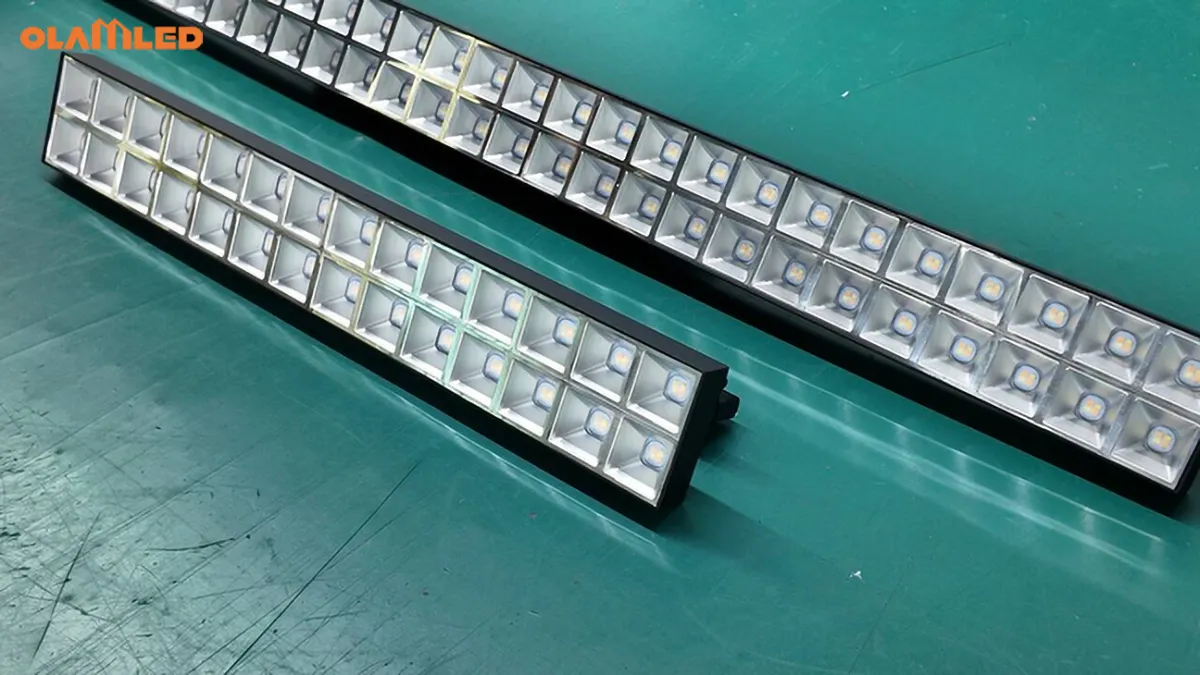
A 620×620 LED panel is a recessed commercial ceiling luminaire whose housing measures 620 × 620 mm, cut for the 625 mm module of German and Austrian system ceilings (Odenwalddecke, Rasterdecke). A catalog “60×60” panel is a different product: a 595 × 595 mm housing for the 600 mm international T-bar module. The two cuts are 25 mm apart, and they are not interchangeable.
The working answer: German and Austrian system ceilings on a 625 mm module take a 620×620 mm panel. Professional catalogs also write 625×625 mm for the same grid; that is the module, not the metal. International and UK T-bar takes a 600 mm module, and the luminaire is usually ~595×595 mm. Measure the opening, not the brochure. A 595×595 panel drops into a 600 mm grid and rattles or gaps in a 625 mm Odenwald grid. That is a size failure, not a glare failure.
Written by the OLAMLED engineering team. OLAMLED is a Shenzhen custom commercial LED OEM/ODM factory (17 years in commercial LED) supplying brand owners, distributors and project specifiers in Germany and the EU. This page covers ceiling commercial LED panel lights only, meaning recessed, surface or pendant Rasterleuchte replacements, not video, photo or therapy panels.
If you also need UGR, 4000 K and DALI-2 for a German office, start with the pillar: LED Panel Light Buying Guide for Germany: Size, UGR & Commercial Specs. This article is the cluster node that goes deeper on one decision: 620×620 mm versus 595×595 mm. So why do German ceilings and international catalogs quote two different numbers for what looks like the same square?
Why German ceilings say 62×62 while catalogs say 60×60
German ceilings say 62×62 because the German and Austrian system-ceiling module is 625 mm and the luminaire cut for that module is 620 mm. Catalogs say 60×60 because the international T-bar module is 600 mm and its luminaire is ~595 mm. Two ceiling modules live side by side in European commercial work: the 600 mm module (UK, much of the rest of Europe, and a large share of Chinese OEM catalogs) and the 625 mm module, the grid people still call Odenwald or Rasterdecke.

Those two numbers are not “almost 60×60.” They are 25 mm of grid and about 25 mm of panel. That is a visible gap on every side if you drop the wrong SKU.
Catalogs mix three labels for the same German product:
| What the document says | What it usually means | Who writes it |
|---|---|---|
| 60×60 / 600×600 | 600 mm ceiling module; luminaire often 595×595 mm | International OEM lists, UK T-bar, T8 grille replacement |
| 62×62 cm / 620×620 mm | Actual panel cut for a 625 mm German/Austrian grid | DE distributors, OEM size tables |
| 625×625 mm / 62.5×62.5 | Ceiling system grid, not the metal of the luminaire | Professional brand families (e.g. LEDVANCE PANEL COMPACT 625) |
A professional 625-family datasheet (manufacturer guidance, LEDVANCE PL COMP 625 V 26W 840 hosted as a public PDF) prints Length 620.00 × Width 620.00 mm for a 625 × 625 mm grid, “suitable for recessed ceiling systems with grid size of 625 × 625 mm,” with recessed / suspended / surface kits as separate accessories. That split, 625 on the ceiling and 620 on the luminaire, is the German office SKU. Source: PL COMP 625 V 26W 840 datasheet (PDF).
On German RFQs the centimeter shorthand is the same cut: 62 × 62 cm means 620 × 620 mm, ordered for Odenwalddecke / Rasterdecke. Measure the opening anyway; a catalog centimeter is not a site tape.
The ceiling manufacturer itself works in the same millimeter band. OWA – Odenwald Faserplattenwerk’s Standard LED (ceiling-system manufacturer guidance) lists a nominal cassette of 625 × 625 × 75 mm and a manufactured luminaire of 622 × 622 mm, compatible with several OWAconstruct systems. A 625 module does not mean a 625 mm box of aluminum.
German mineral-tile systems grew up on a 625 mm planning grid; international T-bar grew up on 600 mm. Factories that only tool 595×595 for “60×60 worldwide” meet that gap on the first German RFQ. The only reliable way to know which module you have is to measure it.
Measure the opening, not the brochure tile
Order the panel cut from the clear opening between the T-bars, measured on site in millimeters (or taken from the ceiling-system drawing). Do not order from the tile printed on the carton or from “60×60” in a Chinese catalog.

How to measure in five minutes
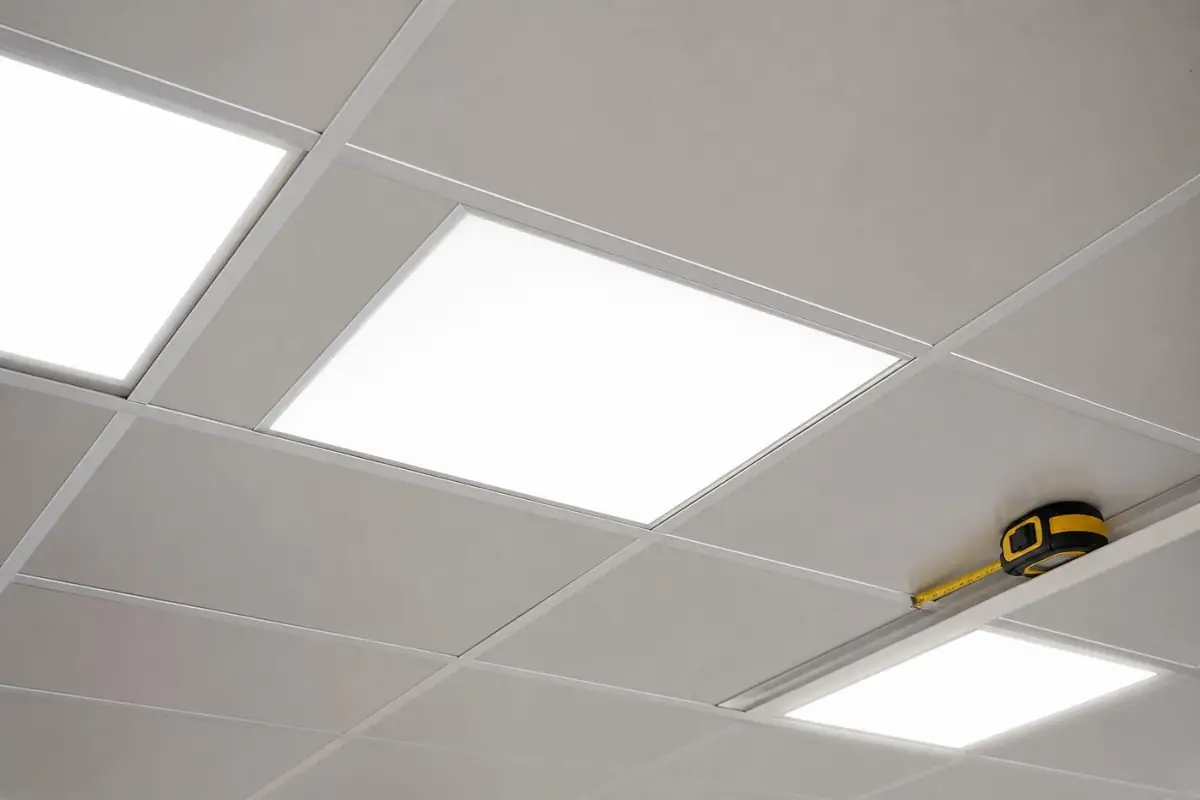
Measuring a Rasterdecke opening takes five steps: identify the ceiling type, tape the inside of the grid, read the module class from the opening, check the void depth, and photograph the tape in the bay.
- Identify the ceiling. Visible T-bar (lay-in Rasterdecke) versus concealed clip-in versus plasterboard versus raw concrete. Only the first two are grid drop-in.
- Measure the opening, not the tile. Tape the inside of the grid, both directions, in millimeters. Do not include the flange of the bar. Measure two bays if the building has been altered.
- Read the module from the opening. A clear opening around 605–615 mm is a 600 mm module (order 595×595). A clear opening around 630–640 mm is a 625 mm module (order 620×620). Exact numbers vary with bar width; the 25 mm class difference is obvious on a tape.
- Check the void. Driver and springs need depth. LEDVANCE’s 625 datasheet lists a 50 mm mounting depth for that family. Treat every brand’s void as a datasheet number, not a guess.
- Photograph the grid with the tape in the shot. On OEM RFQs this single photo prevents a container of the wrong cut.

From factory RFQs: the most expensive “small” error is a distributor who ordered 600×600 because the project schedule said “Rasterleuchte 60×60,” then found an Odenwald 625 on site. The panels arrive. They sit in the grid like a tray on a table that is 25 mm too wide. They rattle in the HVAC return, they show a dark gap on four sides, and the contractor calls it a quality complaint. It is a size complaint.
If you cannot get on site, ask the ceiling contractor for the system name and the nominal module in millimeters. Do not translate “62,5er Raster” into 600.
620×620 / 625×625 vs 595×595: decision table
The decision is mechanical: a measured opening of about 610 mm takes a 595×595 mm panel, a measured opening of about 635 mm takes a 620×620 mm panel, and a building with both grids needs two SKUs. The table maps what you measured or what the drawing says to the cut you should order.

| You measured / you know | Ceiling | Order this cut | Do not order | Notes |
|---|---|---|---|---|
| Opening ~605–615 mm, or “600 mm T-bar / 60×60 grid” | International T-bar; many T8 grille replacements | 595×595 mm (catalog 600×600) | 620×620 | The 5 mm is play so the chassis sits on the T-bar. Same logic as Luxifer’s 600×600 note (manufacturer guidance): 600 is the raster, 595 is the luminaire. |
| Opening ~630–640 mm, or “625 mm / 62,5er / Odenwald / Rasterdecke” | German/Austrian system ceiling | 620×620 mm (catalog 62×62 or 625×625) | 595×595 | A 595 mm / 60×60 panel in a 625 mm grid leaves visible gaps and rattles. |
| Drawing says 625×625, datasheet says 620×620 | Same German grid | 620×620 mm | A literal 625 mm chassis | LEDVANCE 625 family: grid 625, housing 620. |
| Existing 600×600 T8 grille / CAT2 cell | 600 mm T-bar | 595×595 mm | 620×620 | OLAMLED PA 595×595 is the T8-grille drop-in. |
| Mixed floor: some 600, some 625 | Two systems in one building | Two SKUs | One “universal 60×60” | Hold both cuts or survey bay by bay. |
| Plasterboard, concrete, no grid | Not a Rasterdecke | Surface frame or plaster kit; size still 595 or 620 to match the visual module | A grid drop-in with no T-bar | See the mounting section below. |
Luxifer (KLUS, manufacturer guidance) is explicit on the German side: a 595 mm panel does not sit flush in a 625 mm Rasterdecke; you need 620×620 mm or an insert frame. That insert frame is a rescue SKU, not a specification strategy. Specify the right cut.
Side door, not a size topic: once the panel fits, glare is an optic and a room calculation. A rattling 595 in a 625 grid is not a UGR problem. For UGR ≤19 versus UGR <16 in EN 12464-1 offices, see the UGR section of the German LED panel buying guide.
Odenwald / Rasterdecke vs international T-bar: what actually fits
Rasterdecke in German usage is a suspended modular ceiling: metal grid, infill tiles, luminaires laid into the same module. Odenwalddecke is the everyday name for the mineral-tile systems associated with OWA and its peers. Neither word, on a tender, tells you 600 versus 625 by itself (you still measure), but in new German office and school work the 625 mm module is the one to assume until the drawing says otherwise.

What actually drops in:
- Lay-in / Einlegeleuchte. The panel rests on the T-bar flanges. This is the default for both 600 and 625 modules. Safety cable recommended where there is HVAC movement.
- Visible T-bar, 600 mm. International. Panel 595×595. Same opening as a classic 4×18 W T8 grille.
- Visible T-bar or cassette, 625 mm. German/Austrian Odenwald-class. Panel 620×620. Professional brands sell this as a 625 family.
- Concealed / clip-in metal cassettes. The tile is not a lay-in. A standard lay-in panel often does not clip. You need the ceiling-system’s luminaire, a project bracket, or a surface/pendant kit. Do not assume 620×620 “because Odenwald.”
- UK / export 600 mm only. Do not ship 620×620 as a “European” default to a UK warehouse.
Fit is mechanical. A 620 mm chassis on a 600 mm T-bar will not enter the bay. A 595 mm chassis in a 625 mm bay will enter, and that is the trap. It looks installed from a ladder at 6 p.m. On Monday the gap is a black picture frame around every luminaire.
Electrical connection in Germany is the job of a certified electrician (Elektrofachkraft). Dropping the chassis is mechanically simple. Wiring is not. Specify frame stiffness the ceiling contractor will accept, plus a safety tether; a dish in a tired T-bar is not a reason to pick 595. What happens when there is no grid at all?
Plasterboard, surface frames and pendant kits (when grid drop-in is wrong)
A 620×620 panel is a luminaire size, not automatically a grid product. Specify one engine with three kits: to insert (lay-in), to hang (pendant), and with a mounting / surface frame. The 625-family datasheet above lists surface, recessed-frame and suspension kits as accessories, not as the luminaire.

| Ceiling | Kit | When it is the right call | When it is the wrong call |
|---|---|---|---|
| Rasterdecke / T-bar, module confirmed | Recessed lay-in | New or existing grid, opening measured | You guessed 60×60 from a brochure |
| Plasterboard (Gipskarton) | Recessed springs / plaster frame, or surface frame | Cut-out dimension matches the kit drawing | Dropping a grid panel into a hole with no T-bar |
| Concrete / no void | Surface frame (Aufbaurahmen) | Renovation, solid slab | Trying to recess 34 mm into 20 mm of finish |
| High or exposed soffit | Pendant / Seilabhängung (optional up/down) | Atria, industrial-looking offices | Using pendant kits to hide a wrong grid cut |
| Concealed cassette | Project bracket or the ceiling maker’s luminaire | Specified with the ceiling | Forcing a lay-in 620 into a clip-in tile |
Do not use a surface frame as a silent apology for the wrong grid cut. If the ceiling is a 625 Rasterdecke, order 620×620 lay-in. If the ceiling is plasterboard, order the plaster or surface kit and still state 595 or 620 so the luminous square matches adjacent rooms.
Linear formats (1200×300 etc.) for corridors: when not to force a square panel
A square 620×620 is the German office field SKU. It is the wrong default for a 1.8 m corridor, a workstation spine, or a ceiling that was built around T5 1×4 cells; those want a 1200×300 linear panel (~295 × 1195 mm actual).

| Format | Typical actual cut | Use | Do not use when |
|---|---|---|---|
| 620×620 / 595×595 | 620 or 595 mm square | Open-plan bays, classrooms, meeting rooms on a square grid | Corridor centre-line; the grid is 300 mm wide |
| 1200×300 (30×120) | ~295 × 1195 mm | Corridors, T5 1×4 analogue, desk rows | You only stock 620 square and “make it work” with extra fittings |
| 1500×300 | ~295 × 1495 mm | Long corridor runs | Forcing three 620 squares into a linear void |
| 1200×600 | ~595 × 1195 mm | High-output open plan, 600 mm module | 625 mm module; you need the 620-wide analogue, not 595 |
| 300×300 | ~295 mm square | Small fields, 300 mm raster, toilets | Trying to light an open-plan office with them |
| Custom architectural (1100×200, 145×1195, 300×1300, …) | Drawing | Feature ceilings, continuous lines, joinery slots | Default office stock. Custom length is a project SKU. |
Do not force a square panel when the grid is 300 mm in one direction, when the task is a corridor or desk run, when the architect has drawn a continuous luminous line (PA joins modules inside one frame), or when you are filling a joinery slot: measure the slot; do not round it to 620. Custom lengths are a project SKU, not the distributor’s first pallet. Standard 620×620 and 595×595 first. Further cuts: LED module panel light.
Spec / RFQ checklist for distributors and contractors
A complete 620×620 / 595×595 panel RFQ states twelve things: the ceiling module, the luminaire cut, the mounting kit, the void depth, the optic class, color quality, the driver, the proof pack, tender extras, certifications, quantity by cut, and a sample of the actual cut. Never write “60×60” alone.

- Ceiling system and module. Odenwald / Rasterdecke / T-bar / plasterboard / concrete. 600 or 625 mm (measured opening attached).
- Luminaire cut. 620×620 or 595×595. Never “60×60” alone.
- Mounting kit SKU. Lay-in / surface frame / plaster springs / pendant. One line per room if mixed.
- Void depth and driver location. Remote driver in the void vs integrated. Safety cable.
- Optic / UGR class. Office floor UGR<19; screen-heavy UGR<16. Prove it in the room, not only on the sticker. Details: UGR and EN 12464-1 in the Germany guide.
- CCT / CRI / SDCM. German office default 4000 K, Ra ≥ 80, SDCM < 5 (< 3 in one visual field).
- Driver. DALI-2 project default; 1–10 V or Casambi if the bus is already there. Named gear if the spec locks it.
- Proof pack. LDT, UGR table, DIALux/Relux of this floor plate. Confirm turnaround on the RFQ.
- Emergency / sensor / Zhaga Book 18 if the tender asks. Do not add them as a surprise on a stock 620 SKU.
- Certs and labeling. CE, RoHS; ENEC/TÜV/GS if the destination SKU needs them; private-label pack and multilingual manual for OEM.
- Quantity by cut. Count 620 and 595 separately. Mixed buildings are two SKUs.
- Sample. One of the actual cut, in the actual kit, before the bulk PO.
Copy-paste spec line:
Recessed LED panel for German system ceiling, 620 × 620 mm actual (625 mm Rasterdecke / Odenwald) or 595 × 595 mm actual (600 mm T-bar); state which, from a measured opening. 4000 K, Ra ≥ 80, SDCM < 5. Mounting: lay-in / surface frame / pendant as per ceiling. DALI-2. Submit LDT and the matching kit SKU. Do not substitute 595 mm into a 625 mm module.
Common size mistakes factories see on EU RFQs
The ten size mistakes below come from OEM/ODM RFQ patterns at the factory (no named clients). Every one of them is a cut, kit or format error, and every one of them shows up on site as a rattle, a gap or a panel that will not enter the bay.
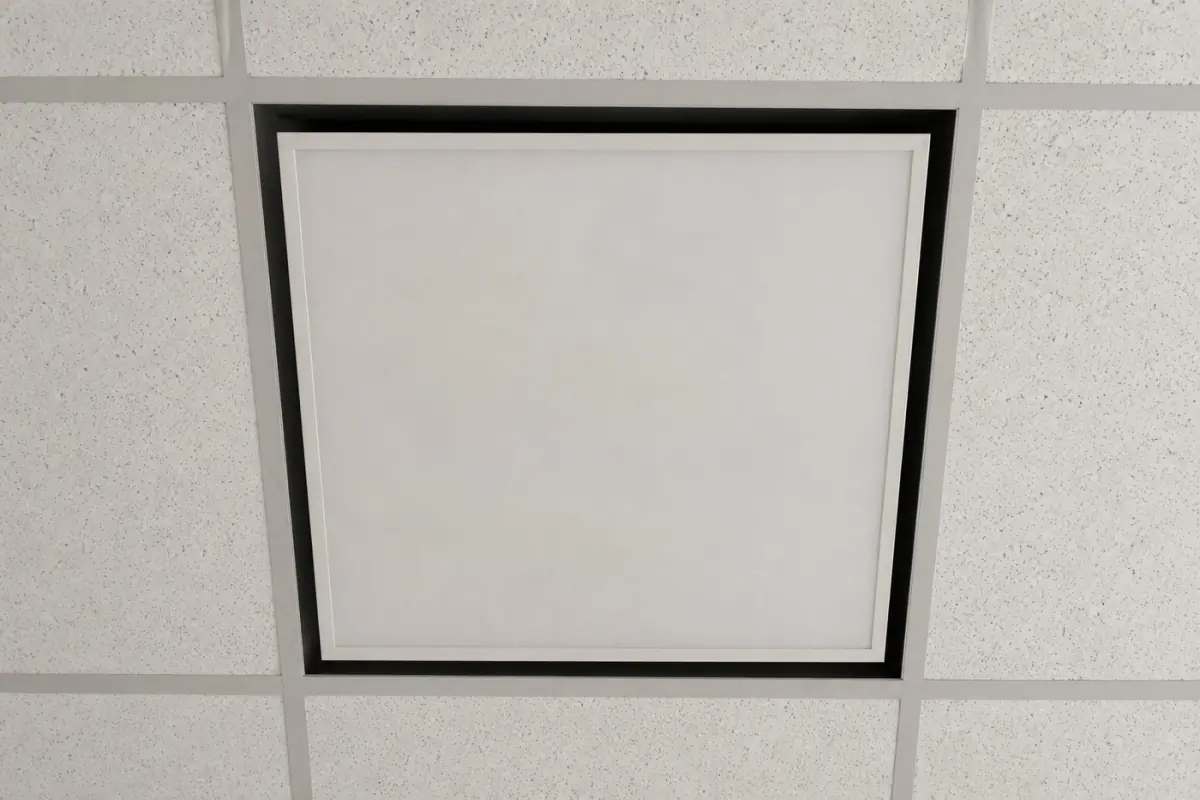
- “60×60 for Germany.” The schedule used the international nickname. The ceiling is 625. The first sample rattles.
- Ordering 625×625 as a housing. The factory builds a chassis that will not enter the bay. The module is 625; the cut is 620.
- One SKU for a mixed building. A 1980s wing on 600 mm T-bar plus a 2015 Rasterdecke on 625. You need both cuts.
- 595 mm “because it will go in.” It will. The gap is then argued as a finish defect.
- Surface frame to hide the wrong cut on a perfectly good grid. Extra cost, extra depth, still the wrong product story.
- Plasterboard ordered as lay-in. No T-bar, no flange, nothing to sit on.
- Square panels in a 300 mm corridor grid. They do not fit. Linear 1200×300 was the fluorescent parent.
- Custom 1100×200 as the office default. Beautiful on a feature ceiling; a stock disaster. Keep custom for the drawing that needs it.
- Forgetting the kit. Fifty 620×620 panels and no surface frames for the concrete meeting rooms.
- Calling a rattle a UGR failure. Occupants see a dark halo. The optic is fine. The cut is wrong. Confirm ceiling commercial panel, not a camera light, and attach a photo of the opening.
Which OLAMLED sizes to ask for (PA 620 / 595)
OLAMLED builds modular, replaceable-engine commercial panels for OEM / private-label and project supply, in both the 620×620 mm Odenwald cut and the 595×595 mm T-bar cut, plus linear and custom lengths. Ask for the cut, then the family, then the kit. Do not start from a sealed residential edgelit SKU and hope the frame stretches.

Standard cuts on the LED module panel light hub and the PA series modular panel light:
| Ask for | Actual size | Ceiling | Family note |
|---|---|---|---|
| PA / PG-2 620×620 (OL-PA30W-6262 class) | 620 × 620 mm | German/Austrian 625 mm Odenwald / Rasterdecke | Default DE office SKU. PA: UGR<19 standard, UGR<16 option, Zhaga Book 18. |
| PA / PG-2 595×595 (catalog 600×600) | 595 × 595 mm | 600 mm T-bar; T8 grille replacement | PA FAQ: the 595 cut drops into the same opening as a 600×600 grille. |
| 300×1200 | 295 × 1195 mm | Corridor / T5 1×4 analogue | Linear modular; do not substitute squares. |
| 300×1500 | 295 × 1495 mm | Long corridor | Custom-leaning stock size. |
| 600×1200 | 595 × 1195 mm | High-output 600 mm module | Check 625-wide analogue if the grid is 625. |
| Custom length (e.g. 1700 × 150 mm class) | Drawing | Feature / continuous run | PA modules join inside one frame; use when the square grid is the wrong tool. |
The PG-2 series UGR<16 panel lists 620×620 and 595×595 (and linear cuts). The CD series UGR<15 louver panel is the choice when the glare brief is already tight; still state the cut. Drivers: On/Off, 1–10 V, DALI-2, Casambi. Recessed, surface or pendant kits on the same engine.
Distributor / OEM path: SKD LED panel light supplier (local assembly of the cut you actually sell) and the LP modular panel light program. Product-family comparison: LED modular panel light product hub.
FAQ: 620×620 LED panels for Odenwald ceilings
These questions come from OEM RFQs and public German size pages, not from fabricated search scrapes. Each answer is short enough to paste into a tender query.

Will a 60×60 LED panel fit a German Odenwald ceiling?
Usually no. A catalog “60×60” is a 600 mm module with a ~595×595 mm chassis. Odenwald / 625 mm Rasterdecke wants 620×620 mm. A 595 mm panel will physically drop in and then rattle and gap. Measure the opening.
Why do catalogs say 625×625 if the panel is 620×620?
625 mm is the ceiling grid. 620 mm is the luminaire. LEDVANCE’s PANEL COMPACT 625 family is named for 625 × 625 mm ceiling systems and dimensions the housing at 620 × 620 mm. Treat 62×62, 620×620 and 625×625 as the same German SKU class, then confirm the millimeters on the drawing.
How do I measure so I order the right cut?
Tape the clear opening between T-bars, both ways, in millimeters. ~610 mm class → 595×595. ~635 mm class → 620×620. Photograph the tape in the bay. If there is no T-bar, you are in plasterboard or concrete: pick a kit, not a guess.
Can I use a surface frame if I ordered 595 mm for a 625 mm grid?
You can hang or surface-mount a 595 mm panel on a solid ceiling. You cannot make a 595 mm lay-in look like a 625 mm tile. On a Rasterdecke, return the wrong cut or use a proper insert frame as a one-off rescue, then correct the SKU for the rest of the floor.
When should I use 1200×300 instead of 620×620?
Use 1200×300 in corridors, T5 1×4 replacements, and any ceiling whose module is 300 mm in one direction. A square 620 is an office-bay luminaire. Forcing it onto a corridor centre-line wastes fittings and looks like leftover stock.
Does panel size change UGR?
Not by itself. UGR is a room result (optic, layout, reflectances, observer). A 25 mm gap around a 595 mm panel in a 625 mm bay does change what occupants see, as a dark halo and a rattle, which then gets blamed on glare. Fix the cut first. Then specify the optic with the UGR guidance for German offices.
Are video or photo LED panels the same product?
No. This article is about ceiling commercial LED panels. Camera lights (NEEWER, Nanlite) and therapy panels are different products that collide on the English query “LED panel light.”
Order the cut, then finish the spec
620×620 versus 595×595 is not a styling choice. It is a ceiling-module decision. German Odenwald / Rasterdecke work defaults to the 625 mm grid and the 620 mm panel. International T-bar defaults to 600 / 595. Linear 1200×300 is for corridors. Custom lengths are for drawings that the square grid cannot serve.

Return to the LED Panel Light Buying Guide for Germany for UGR, 4000 K and DALI-2 on the same specification. For a DIALux pack, a 620×620 sample (MOQ 1 on the modular program) or an OEM / SKD RFQ, use the modular panel program, the SKD LED panel light supplier page, or contact OLAMLED.