An OEM LED panel light buying guide is a procurement brief for distributors, importers and private-label brand owners who will own a commercial ceiling panel as a catalog SKU, with their own logo, carton and after-sales. It is not a project specification for one room. This one is written for Germany and the wider EU.
Most first RFQs say “send me your 60×60.” What comes back is a sealed white box: an unknown driver, a UGR number with no LDT, and a GS mark you cannot print until a certificate names that model.
The working answer: a first RFQ needs four decisions: grid (620×620 vs 595×595), glare class, driver protocol, and SKD versus boxed goods. Then ask for LDT/IES, a UGR table with room assumptions, Pst LM / SVM on the driver, CE/RoHS files per SKU, and a one-piece sample before you freeze artwork.

Below: the copy-paste RFQ, the proof files that change your proforma, and the pilot steps that keep bulk matching the sample. Already know your four decisions? Skip to the copy-paste RFQ and send it with your sample request.
Specifiers modeling EN 12464-1 rooms should start with the LED Panel Light Buying Guide for Germany. Size, glare and protocol each have their own cluster doors: 620×620 for Odenwald ceilings, UGR 19 vs UGR 16 (in the Germany guide), and DALI-2 LED panel dimming. Sampling, SKD kits and 1 pc MOQ sit on the modular panel light program (LP).
Who this OEM LED panel buying guide is for, and who should leave now
You belong here if the SKU will carry your logo, your carton and your after-sales.
- EU distributors and wholesalers. A stockable 600×600 and 620×620 range, three mounting kits (recessed, surface, pendant), and a clear story against sealed commodity panels.
- Importers and OEM/ODM private-label buyers. A logo on the luminaire and carton, multilingual manuals, an NDA when the housing is yours, and a sample that matches bulk.
- Local assemblers. SKD kits (module, frame, driver, optic) to manage duty, mix and after-sales.

Writing one office, school or healthcare tender? You are a specifier, and the Germany buying guide is your page. Video, photo and red-light therapy panels are out of scope here.
OLAMLED is a commercial LED manufacturer with 17+ years in design and production. The factory focus is modular panels: UGR<16 families, named driver options including DALI-2/D4i, custom size including 620×620, 1 pc MOQ, SKD and private label. Confirm lead times and certificates on the current SKU with sales before they enter a tender or a print run. So what exactly goes on that first enquiry?
What to put on the first RFQ
A vague enquiry produces a sealed white box. A precise one produces a proforma you can sign.
Name the SKU you intend to sell:
- grid cut
- optic class
- protocol
- finish
- packaging language
- finished goods or SKD for the first warehouse fill

The four RFQ decisions: grid, optic, driver protocol, SKD or finished
Four decisions freeze the platform: the grid millimeters, the glare optic, the driver protocol, and whether the first warehouse fill is SKD or finished goods. The first three go in the table below; the fourth has its own section.
| Field | Specify this | Why it matters in DE / EU |
|---|---|---|
| Size / grid | 620×620 mm for Odenwald / Rasterdecke (~625 mm module); ~595×595 mm for 600 mm T-bar; 300×1200 / 600×1200; custom | A 595 mm panel rattles or gaps in a German 625 grid. Measure the opening, not the brochure. Side door: 620×620 Odenwald guide. |
| UGR target | UGR ≤19 office floor; UGR <16 screen-heavy upgrade; UGR <15 premium louver | UGR is a room calculation. Demand LDT plus a stated reference room, not a sticker. Side door: UGR 19 vs UGR 16 in the Germany guide. |
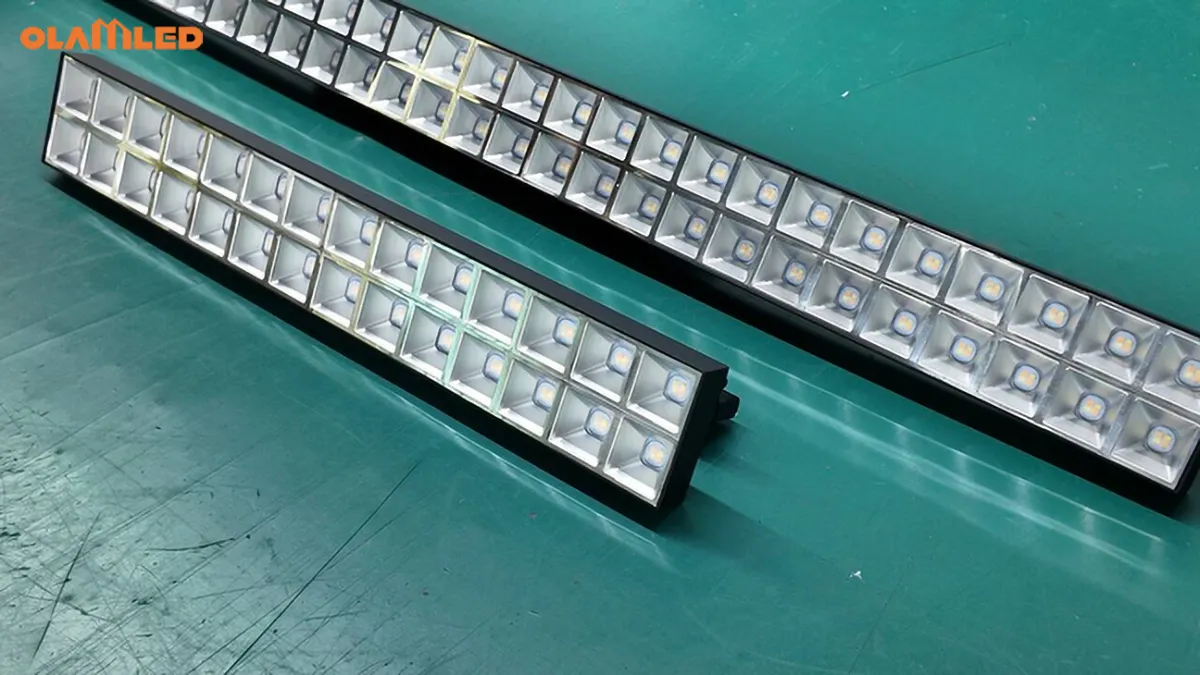
| Optic / construction | Modular louver/reflector vs microprisma vs opal; frame color; reflector cups (white, black, silver, clear as listed) | Replaceable engines are the SKD story. Opal is not a VDU optic. |
| Driver protocol | On/Off; 1–10 V / 0–10 V; DALI-2 DT6; DALI-2 DT8 tunable white; D4i; Casambi. Named brand if the channel locked one. | Write the protocol, not “dimmable.” TRIAC only on drivers rated for phase-cut. Side door: DALI-2 dimming guide. |
OLAMLED modular families (PA, PG-2, CD and related louver series) use UGR<16 optics, custom lengths and 620×620 on PA. Confirm lumen packages on the current datasheet: the modular program spans roughly 120–160 lm/W; PA-class around 140 lm/W; PG-2 listed up to 160 lm/W at Ra 80 and 150 lm/W at Ra 90.
“Dimmable” is not a protocol. Write one of these on the RFQ:
- On/Off; 1–10 V / 0–10 V
- DALI-2 DT6; DALI-2 DT8 tunable white; D4i
- Casambi
If the tender names a driver brand, say so. Tridonic, Philips, Osram, Lifud and Boke are the options listed on the modular hub.
Three fields buyers forget:
- Mains: 220–240 V.
- IP: office panels are typically IP20–IP40.
- Emergency: an optional self-contained pack (OLAMLED lists 3–5 W, 180 min, ≥10% output, LiFePO₄, test button). It is not a building-code guarantee.
Sensor brand undecided? PA lists a Zhaga Book 18 opening, so you can leave it open at the first RFQ.
Put the commercial fields on the same enquiry, so the first proforma is the last one you have to re-issue:
- Logo on luminaire and carton
- Manuals: DE/EN at minimum for DACH
- Export pack or retail pack
- Drop-test expectation
- Incoterms
- HS heading (typically 9405)
- EU responsible person, if you place the goods on the Union market
MOQ is 1 pc on the modular program. Printed cartons and new molds often carry a print-run floor.
Published lead times on the modular program: drawings about 3 days, samples 3–5 days (custom work cites up to 7 days), delivery around 20 days. Lock the dates on the proforma for your SKU.
Copy-paste RFQ:
620×620 mm (or 595×595) modular LED panel, 220–240 V. UGR target <16 in a stated 4H×8H / 70/50/20 reference room. 4000 K, Ra ≥80, SDCM <3 or <5. Driver: DALI-2 DT6 (quote DT8 / 0–10 V / D4i as options), named brand. Pst LM and SVM on the driver datasheet. LDT + IES, DIALux/Relux. Recessed + surface + pendant kits. IP as specified. Emergency 180 min optional. Private-label artwork and multilingual manuals. SKD or finished goods. MOQ, sample lead time, aging protocol, warranty years and L70/L80. Confirm CE/RoHS files per SKU; flag if GS/TÜV/ENEC will be requested.
SKD versus finished goods: which warehouse problem you are solving
Which one is “better”? Neither. They solve different warehouse problems.
Finished goods arrive as a complete boxed luminaire. Right for you if you have no assembly bench and want origin QC and a frozen SKU. The trade-off: higher freight cube, and the mix is frozen at the factory.
SKD arrives as a kit: LED module/PCB, DC leads, housing/frame, driver, optic, branded pack, label and manual. Right for you if you already assemble, or need control over duty, cube and mix. One engine feeds several frames or glare classes, so a color or length request does not mean a new SKU.

What SKD does not do: it does not skip CE marking, incoming inspection, or a technical file that matches the assembled SKU. If you place the product on the EU market, importer obligations remain either way. OLAMLED’s SKD offer matches that kit list, with drivers by function and brand and emergency or sensor packs as add-on modules. Kit contents and families: modular panel light LP.
A practical split we see on OEM programs: finished goods for the hero 620×620 UGR<16 DALI-2 SKU; SKD for custom lengths, colors and project spikes. Either way, the next question is the same: what proof do you demand before the proforma?
The proof pack: four QC questions that change your proforma
These four questions change the proforma. If a factory cannot answer them, you are buying a residential SKU with a commercial label.

Aging. Request duration, load, sample size and pass/fail. OLAMLED lists aging, goniophotometer, integrating-sphere and photoelectric tests as in-house capabilities; ask which run on your batch.
Photometry. LDT is the DE/EU default; add IES if needed. Include a UGR table for a named room (for example 4H×8H, 70/50/20) and, for VDU tenders, luminance at γ=65°. UGR is not a sticker.
Flicker. EU professional datasheets commonly print Pst LM ≤1.0 and SVM ≤0.4 at full-load under Commission Regulation (EU) 2019/2020, Annex II. Ask for those numbers on the driver you will buy, over 10–100% dimming and occupancy cycling. “Flicker-free” is a slogan, not a number. Put Pst LM and SVM on the RFQ.
Warranty and L70. OLAMLED states a 5-year warranty on the modular LP. Pair it with L70/L80 and the test method. Ask what is covered (engine, named driver, field labor), how RMAs work, and whether spare modules are stocked. Also: IQC, SMT traceability, drop test, who signs the DoC, and factory access.
CE, RoHS, and when GS / TÜV / ENEC is actually requested
For a luminaire placed on the EU market, the working set is CE (LVD, EMC, applicable ecodesign rules) plus RoHS. Official overview: CE marking obligations. OLAMLED’s LP displays CE and RoHS certificate artwork, a starting point, not a substitute for the current Declaration of Conformity and reports on the exact model, driver and optic.

Request per SKU: matching DoC; LVD/EMC/RoHS reports from a named lab; photobiological class (ask for RG0, do not assume); replaceable driver and, with modular panels, a replaceable engine.
GS, TÜV and ENEC are often requested by German wholesale and some tenders. They are not automatic with CE. Budget them if your channel prints “TÜV/GS,” and write “available / on request for this SKU.” Do not print those marks on a private-label carton unless the certificate lists that model. Do not invent a factory-wide ISO year as a substitute for SKU files.
If you are the importer, you (or your authorized representative) are the economic operator. SKD does not outsource that. Installed wiring in Germany is Elektrofachkraft work; say so in the catalog.
Is your OEM LED panel a rebadge? Six checks that replace guessing
“Don’t a handful of Chinese factories make every panel, and everyone just rebadges?” Often, yes. Rebadging is normal.
Opacity is the risk. Four forms of it: a datasheet that does not match the carton; a driver swapped after sampling; a UGR number with no LDT; a factory you have never seen.

Six checks replace the guessing:
- Named components. LED and driver brands on the PI, not “equivalent.”
- Photometric proof. LDT for your optic and housing, not a cousin model.
- Sample lock. Golden sample signed off; any LED/driver change is a new sample.
- Factory access. SMT, aging, goniophotometer; NDA before detailed drawings; third-party audit if volume justifies it.
- Traceability. Batch codes that survive to a field RMA.
- One platform, two glare classes. Hold UGR<19 and UGR<16 on the same modular engine so you are not shopping a random white box every quarter.
Judge a factory on files and a pilot, not on a homepage. Here is how that pilot runs.
Sampling and pilot-order playbook
An OEM panel program moves from discovery to bulk in six steps, and the two that break most programs are the engineering sample and the pilot lot. Do not skip the pilot because a desk sample looked good.
- Discovery. Grid, optic, protocol, SKD vs finished, markets, volume band; NDA if the housing is yours.
- Paper pack. Drawings (about 3 days on the modular program), driver shortlist, CE/RoHS file list; DIALux/Relux if you send a room. Confirm turnaround on the RFQ.
- Engineering sample. 3–5 days published; confirm the 7-day custom window if needed. Test grid fit, DALI, dimming, emergency, artwork.
- Photometric send-out. LDT and flicker; freeze the BOM.
- Pilot. One warehouse location and one live project; IQC, aging spot-check, drop test, DoC.
- Artwork freeze and bulk. Carton print, spare engines, RMA SOP, driver EOL rule. Delivery around 20 days is the published figure; lock it on the PI for your SKU.
How to run an OLAMLED OEM / SKD program
OLAMLED’s modular program is built for catalog ownership, not one-off white-box shopping: one replaceable engine, two grids, three kits, private-label artwork, then SKD or finished goods for the warehouse model you actually run.

| Step | What you lock | Where it lives |
|---|---|---|
| Platform | UGR<16 modular families; 120–160 lm/W class; replaceable engine | LP, module hub, product hub |
| Families | PA (incl. 620×620, Zhaga Book 18 option), PG-2 (UGR<16 reflectors), CD (UGR<15 louver) | PA, PG-2, CD |
| Control | On/Off, 0–10 V / 1–10 V, DALI-2/D4i, Casambi; named gear on request | Protocol node: DALI-2 guide |
| Fulfilment | Finished goods and/or SKD kit (module, frame, driver, optic, pack, label, manual) | OEM/ODM services |
| Cadence | Drawings ~3 days; samples 3–5 days (custom ≤7 days); delivery ~20 days; 1 pc MOQ; 5-year warranty on modular LP | Confirm every date on the current SKU quotation |
Private-label packaging, language packs and driver substitution rules sit under OEM/ODM services. For a room-side brief (lux, UGR, EN 12464-1), stay on the Germany pillar.
OEM LED panel FAQ for EU distributors
Seven questions that come up on EU distributor and private-label RFQs.

What is the difference between an OEM LED panel program and a project specification?
A project specification buys a room: lux, UGR in DIALux, DALI addresses. An OEM program buys a catalog: one engine, two grids (620 and 595), three kits, private-label artwork, MOQ and spare parts. Use this page for the program; use the Germany buying guide for the room.
Can I private-label 620×620 and 600×600 on the same platform?
Yes. That is the point of a modular factory. Specify both cuts on the RFQ so the engine, driver and optic stay common and only the frame changes. PA lists 620×620; ~595×595 is the usual 600 mm T-bar cut.
Should a first EU import be SKD or finished goods?
If you have no assembly bench, start finished. If you already assemble or want duty and mix control, SKD. Many buyers run finished goods for stock SKUs and SKD for custom color and length. SKD does not remove CE marking or incoming inspection.
What proof pack should I refuse to proceed without?
LDT (plus IES if needed), a UGR table with room assumptions, the driver datasheet with Pst LM/SVM, a current CE/RoHS DoC for that model, and a golden sample that matches the proforma. “UGR<19” on a webpage is not a proof pack.
Does OLAMLED hold GS or TÜV as standard on every panel?
Do not assume it. CE and RoHS are the baseline; GS, TÜV and ENEC are available on request per SKU and per channel. Ask sales for current certificates on the exact model, and budget extra if German wholesale customers require GS.
What MOQ and sampling time should I plan for?
Plan on 1 pc MOQ, drawings in about 3 days, samples in 3–5 days (up to 7 days for custom work) and delivery around 20 days, the figures OLAMLED publishes for the modular program. Custom cartons, molds and special housings take longer. Get every date in writing on the quotation.
How do I reduce the chance that bulk does not match the sample?
Lock the bill of materials on the proforma: LED code, exact driver model, optic, paint. Require written approval for substitutions. Keep one golden sample. Run a pilot lot through warehouse IQC before the print run for retail cartons.
Lock the SKU, then order the sample
An OEM LED panel program is not a feature ladder. It is a catalog lock plus a proof duty. Freeze the four RFQ decisions, demand the photometric and compliance files for that SKU, then sample the exact optic and driver you will sell before you print the carton.
Send OLAMLED the SKU you intend to sell, and get a one-piece sample plus the certificate list for that exact model. Put these seven lines in the enquiry:
- Destination country
- 620×620 or 595×595
- UGR class
- Driver brand / protocol
- SKD or finished goods
- Private-label languages
- Whether GS / TÜV / ENEC will be requested
Send the RFQ and lock sampling days for this SKU →
1 pc MOQ. Samples 3–5 days on the modular program.
Related: modular panel program (families, SKD kit list) · OEM/ODM services (private label, packaging) · Germany buying guide (specifier side).
Written by the OLAMLED engineering team. OLAMLED is a Shenzhen custom commercial LED OEM/ODM factory with 17+ years in commercial LED, supplying brand owners, distributors and project specifiers in Germany and the EU. This page covers ceiling commercial LED panel lights only (recessed, surface or pendant Rasterleuchte replacements for catalog and private-label programs), not video, photo or therapy LED panels.