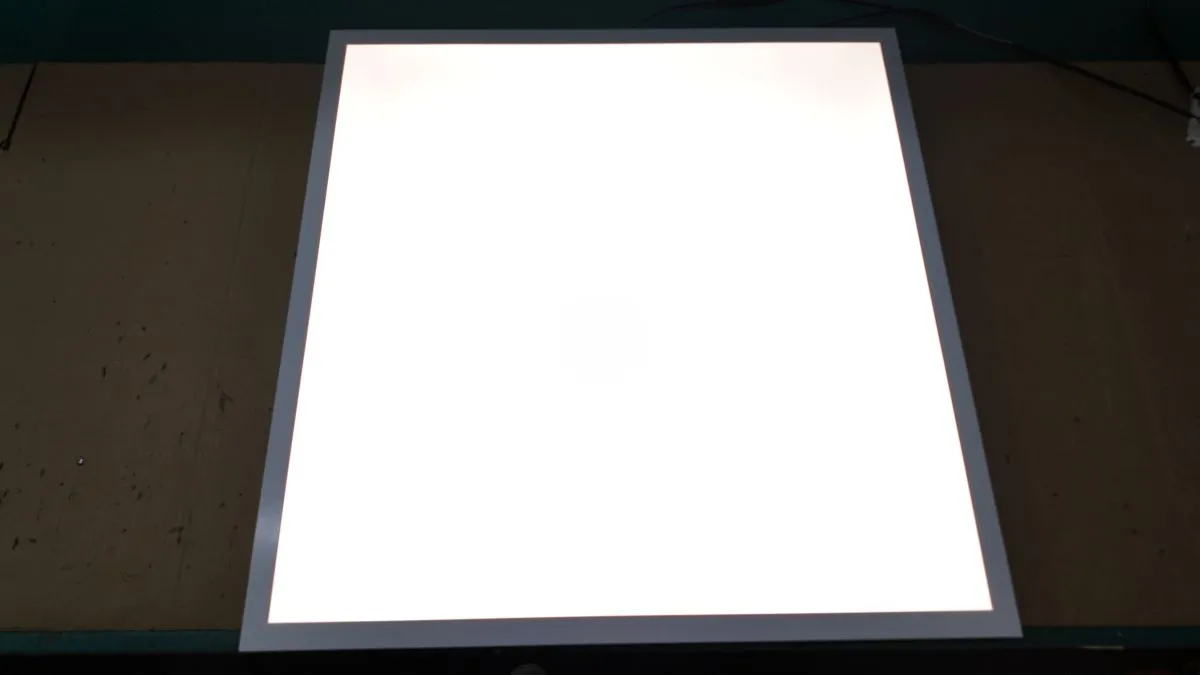
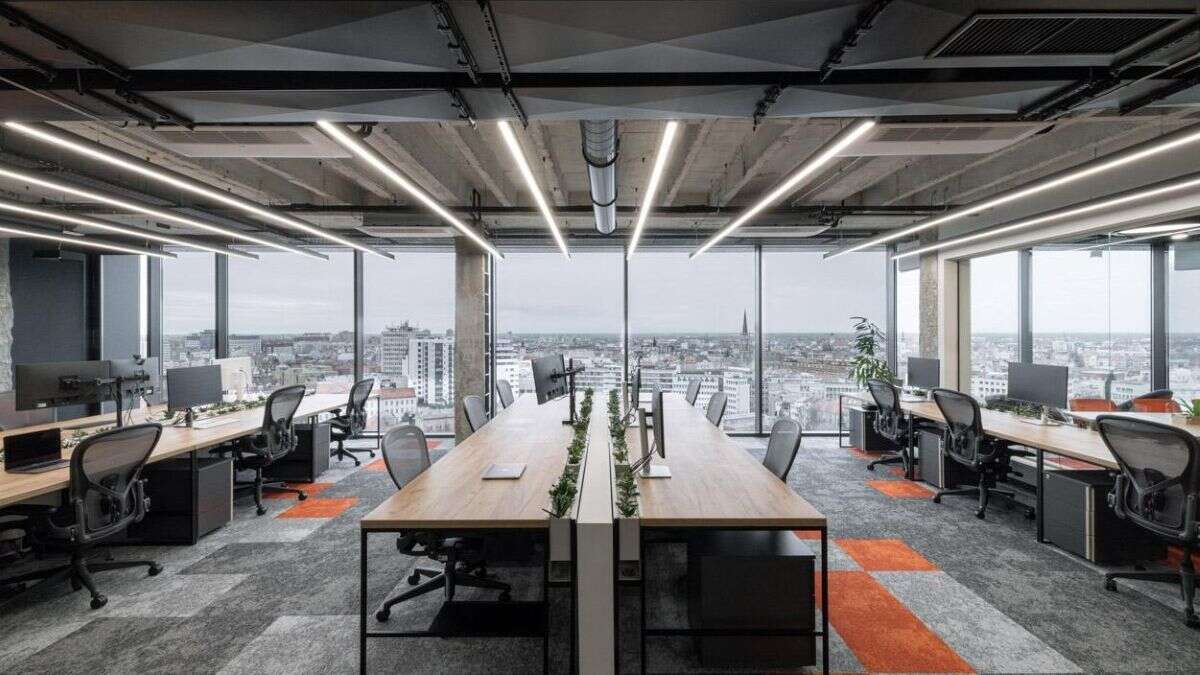
A recessed LED panel light can pass every desk review and still fail on site. The panel is 5 mm too wide for the grid. The driver sits behind a duct nobody surveyed. The “low glare” label turns out to belong to a different diffuser. Multiply one of those by 400 rooms and you have a rework bill that was never in the budget.
This guide is for the people who have to sign the RFQ: specification engineers, procurement teams, contractors and distributors buying panels for commercial projects. It works through the decisions that decide whether a panel performs in the ceiling, not just in the catalogue, and ends with a free RFQ workbook you can issue to suppliers.
Short on time? Jump to the decision matrix or download the workbook.
What Should a Recessed LED Panel Light Specification Include?
A usable specification covers eleven things: the ceiling interface, delivered light, optical distribution, glare target, colour quality, driver, controls, emergency function, compliance market, service access and supply terms. Every one of them should point to a drawing, test report, file, approved sample or inspection record for the exact model being quoted.
Here is the RFQ starting list we recommend:
- Ceiling: grid module, clear opening, T-bar width, tile type, plenum depth and obstructions
- Fixture: outer size, body depth, weight, support method, driver location and access route
- Light: delivered lumens, system watts, luminaire efficacy, distribution and maintained-lighting target
- Colour and comfort: CCT, CRI, SDCM, optic, diffuser and project glare limit
- Electrical: supply voltage and frequency, driver model, power quality requirements and connector type
- Controls: on/off, 1–10 V, 0–10 V, DALI-2, sensors or emergency operation
- Evidence: drawings, photometric files, test reports, declarations, installation instructions and warranties
- Supply: quantity, approved sample, MOQ, lead time, packaging, labels, spares and change control
Notice what is not first on that list: wattage. Two panels can draw the same 36 W and still differ in output, distribution, glare, colour and dimming. Wattage tells you what the fixture consumes. It says nothing about what the room gets.
Does the Panel Fit the Ceiling System?
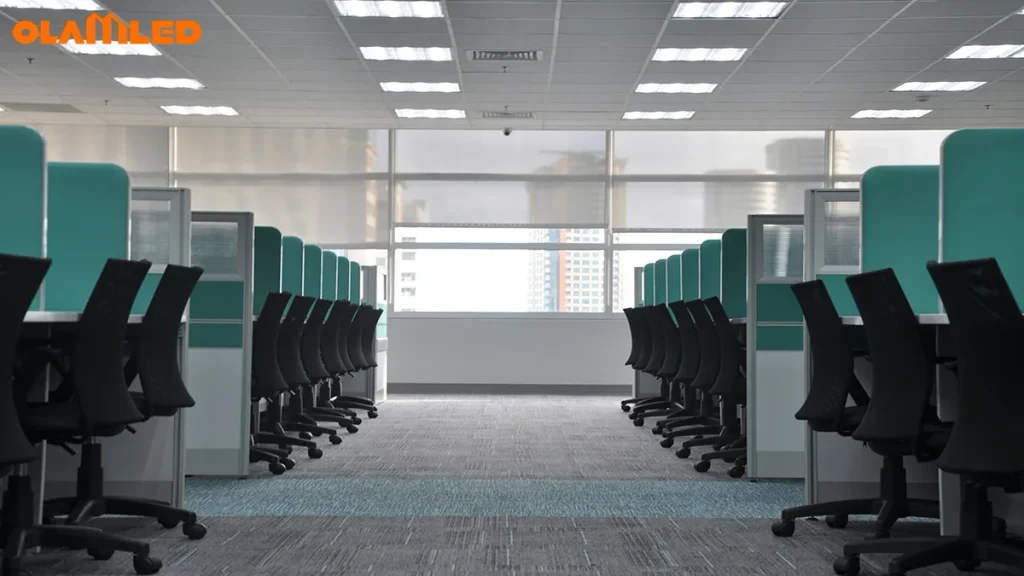
Check four dimensions before you compare a single price: the nominal ceiling module, the clear opening, the panel’s outer dimensions, and the depth needed for fixture plus driver. Why four? Because a label such as “600 × 600” usually describes the ceiling module, not the panel that arrives in the carton.
A 600 × 600 mm T-grid, for example, normally takes a panel of about 595 × 595 mm. German Odenwald and Rasterdecke ceilings use a 625 mm module and need a 620 × 620 mm panel instead. North American 2 × 2 ft grids, narrow linear modules and custom layouts each have their own numbers. None of these convert into each other by assumption. If the project is in Germany, our 620 × 620 panel guide for Odenwald ceilings covers that case in detail.
The survey items differ by ceiling type:
- T-grid ceilings: T-bar width, grid load limit, tile thickness, suspension layout and the route used to insert the panel
- Plasterboard ceilings: finished cutout, trim, support frame, clip position and cutout tolerance
- Both: any independent supports or restraints required by the local design

Plenum and service space
Measure usable depth at every fixture zone, not just the one open bay where the survey started. Ducts, sprinklers, cable trays, fire barriers and structural members can all block the driver or stop the panel being tilted into position.
OLAMLED publishes standard and custom dimensions across its modular LED panel light range, and the listings separate the ceiling module from the actual fixture size. Use that for early planning. Then approve the dimensioned drawing for the selected model and mounting kit before anything is ordered.
How Should Buyers Compare Lumens, Wattage and Efficacy?
Compare delivered lumens, input power and luminaire efficacy for the complete quoted configuration. The evidence has to match the CCT, CRI, optic, diffuser, driver and dimming option you selected. A family’s headline efficacy belongs to one model in the range. It should not be pasted onto every other one.
Use this five-step review:
- Set the lighting criteria for each room and task.
- Obtain the matching IES or LDT file.
- Calculate with the actual room geometry, reflectances, mounting height and layout.
- Check maintained illuminance, uniformity, glare and connected load.
- Confirm the report and file revision against the quotation and the sample label.
ANSI/IES LM-79-24 defines how solid-state lighting products are measured: total luminous flux, electrical power, system efficacy, intensity distribution and colour quantities. Ask for an LM-79 report, or an equivalent accredited report, that names the tested model and its operating conditions.
One more separation matters: initial output versus maintained output. Run the calculation with the project’s approved maintenance factor. Initial lumens are a day-one number, not a promise for year five.
Is “UGR Below 19” Enough to Control Glare?
No. UGR is a property of the installation, not of the panel. It depends on source luminance, apparent size, room background, observer position, view direction, mounting height, spacing and orientation. A product label helps you shortlist. Only a calculation with the correct photometric file and the real room can prove the layout meets its glare criterion.
The CIE 117 discomfort-glare method builds observer position and viewing direction into the formula, which is exactly why one catalogue number cannot describe every room. CIE also warns that strongly non-uniform LED sources need extra care when their average luminance hides visible high-luminance spots.
For each room, confirm that:
- The photometric file matches the proposed optical code
- Luminaire orientation matches the calculation
- Reflectances and mounting height are realistic
- Normal observer positions and view directions are included
- High-angle luminance or source appearance has been reviewed
- The approved sample has the same diffuser, lens, reflector and output setting
OLAMLED lists low-glare modular options and publishes model-dependent optical data. Our edge-lit LED panel light page shows how much glare performance shifts with the optical configuration. Write the exact optic code into the purchase order. “Low glare” on its own is not a specification.
Which Driver and Control Details Prevent Site Problems?
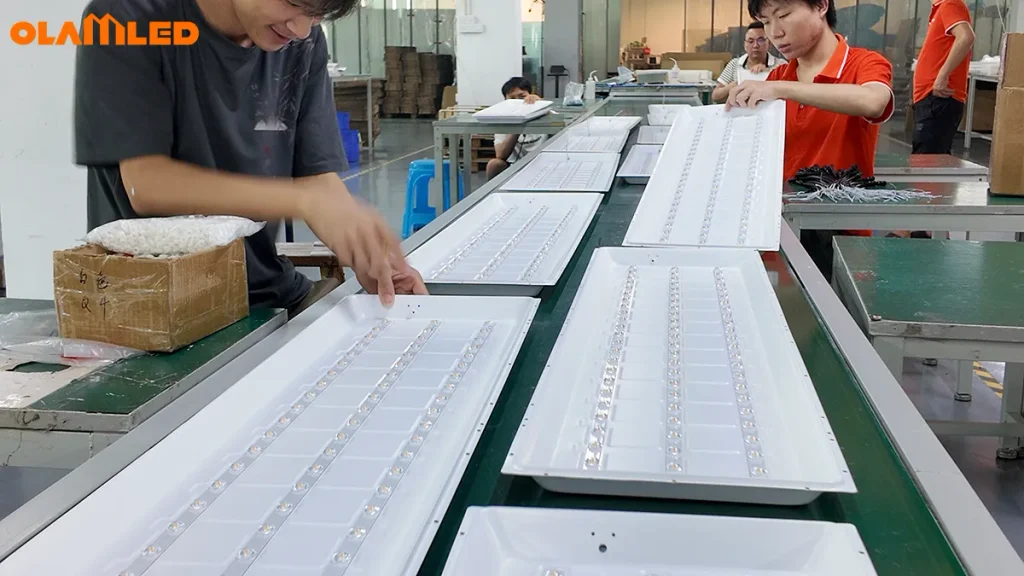
Treat the driver as part of the luminaire, not as an accessory that can be swapped later. Record the exact model or an approved performance class, supply range, output current, dimming protocol, minimum dim level, off behaviour, emergency arrangement, connector, service location and any limits set by the building control system.
The driver schedule should cover:
- Input voltage, frequency, output current and allowable LED load
- Power quality limits required by the project
- DALI-2, 1–10 V, 0–10 V, on/off or another approved interface
- Minimum light level, dimming curve, off behaviour and analogue-control details
- Emergency duration, test method, indicator and control interaction
- Driver temperature limits, access method and approved replacement
Do not use “DALI” and “DALI-2” as if they carried the same evidence. The DALI Alliance certification program verifies test results independently, and certified control gear is traceable in its public database. So ask for the driver brand, model, hardware version and certification status, then check the database yourself. If the project is still choosing a protocol, our DALI-2 panel dimming guide compares DALI-2, 1–10 V and the other common options for commercial panels.
For analogue dimming, test the proposed driver with the actual controller or an approved equivalent before mass production. Check low-end stability, switch-off behaviour, control wiring, emergency interaction and any sensor delay. A 30-minute bench test costs far less than 400 flickering panels.
Can the Driver Be Serviced Without Damaging the Ceiling?
A recessed panel is only maintainable when an electrician can isolate it, support and lower it safely, reach the driver and connectors, and fit an approved replacement without cutting the ceiling. That access route belongs in the reflected ceiling plan, the fixture detail or the method statement. A sales brochure is not the place for it.
Confirm four things: the panel can be removed from below, a remote driver passes through the opening, the cable allows a safe service loop, and the route does not cross a protected ceiling zone. Then record which parts are field-replaceable and how long matching spares will stay available.
“Modular” also needs a definition. Replaceable modules cut waste and repair time, but only if you know whether replacement needs tools, whether it can be done below the ceiling, and whether the new part keeps the original output, colour, optic and control settings.

Which Documents Should Be Model-Specific?
Every important claim should resolve to the quoted model code. The minimum submittal is:
- Signed model code and dimensioned mechanical drawing
- Matching IES or LDT file, plus the optical and electrical report
- Driver datasheet and control certification
- Safety and EMC evidence for the destination market
- Installation instructions
- Warranty terms, claim process and replacement-parts policy
- Traceable component or batch information
Where a lumen-maintenance claim relies on LM-80 and TM-21, ask for the source data and a valid projection, not just the headline hours.
The U.S. Department of Energy’s LED luminaire lifetime recommendations make the point clearly: LED-package lumen depreciation is not a proxy for luminaire life. Drivers, connectors and thermal interfaces bring their own failure modes. Ask how the whole product claim is supported, not only which LED package is inside.
For international projects, IEC 60598-1:2024 covers general luminaire safety and IEC 62722-2-1 covers LED luminaire performance testing. Name the destination market and applicable standards in the RFQ. The supplier should then state which documents cover the exact construction offered.
How Do Buyers Control Batch Consistency and Substitutions?
With four tools: a golden sample, an approved bill of materials, measurable production tolerances and written change control. A good pre-production sample protects nothing if the driver, LED package, diffuser, connector, housing finish or firmware can change later without review.
Define acceptance limits for CCT, SDCM, CRI, lumen output, power, efficacy, dimming and emergency behaviour. Lock the driver, optic, diffuser, LED package, connector, housing, surface finish, labels and carton marks, or define a written equivalent-approval process. Require batch and production-date traceability.
State in writing which changes need approval. If a substitute driver is proposed, repeat every check that change affects: dimming compatibility, temporal light behaviour, EMC, emergency operation, output and thermal conditions.
For repeat orders, keep the golden sample, approved document revisions and inspection record together. That is what makes a reorder six months later match the first delivery.

What Belongs in a B2B RFQ Beyond the Datasheet?
Supply terms. A complete RFQ pairs the technical requirements with MOQ, sample timing, production lead time, phased-delivery capacity, OEM/ODM scope, packaging, inspection plan, spare parts and warranty process, all for the exact configuration rather than the product family.
Break quantity down by size, wattage, CCT, optic, driver and destination, then request for each combination:
- MOQ for that specific configuration
- Sample and production timing
- Phased-delivery capacity
- Label, manual, barcode, carton and pallet requirements
- Transport-test basis, spare parts and inspection package
- Warranty-claim process
Why so granular? Because a special frame, certified driver, emergency pack, low-volume CCT or printed carton can change both MOQ and lead time. Require the supplier to state its assumptions and quotation validity dates.
The RFQs that reach OLAMLED most often start with one line: “600 × 600, 40 W, 4000 K, best price.” That line cannot be quoted accurately, so it gets quoted generically. Send a configuration schedule instead. For reference, OLAMLED has built commercial panels for 17 years, ships project samples in 3–5 working days, runs production in 20–25 working days and backs the product with a 5-year warranty. Custom sizes, drivers, modules, labels and packaging are handled through our custom commercial lighting service. Distributors specifying under their own brand can start with the OEM panel light buying guide.
Recessed LED Panel Light RFQ Decision Matrix
Use the matrix below to keep design, procurement, installation and quality teams working from the same evidence.
| Decision area | Specify in the RFQ | Evidence to approve | Main risk controlled |
|---|---|---|---|
| Ceiling fit | Module, opening, outer size, depth, weight, support | Drawing, ceiling detail, sample fit check | Rework and installation delay |
| Light output | Lumens, watts, efficacy, distribution | Matching report and IES/LDT file | Low light, poor uniformity, excess load |
| Glare | Room criterion, layout, viewing conditions | Photometric file, UGR data, room calculation | Discomfort and failed design review |
| Colour | CCT, CRI, SDCM, tolerances | Test evidence and batch inspection method | Mixed appearance between zones |
| Driver | Exact model, input, dimming, access | Datasheet, certification, compatibility test | Flicker, control failure, hard maintenance |
| Compliance | Destination and required standards | Valid documents for the offered construction | Approval delay or rejected shipment |
| Supply | MOQ, lead time, packaging, spares, change control | Signed quotation and quality plan | Unstable repeat orders and schedule risk |
Download the Project RFQ Workbook
Turn the matrix into an issue-ready enquiry. The Recessed LED Panel Light Project Specification & Procurement Checklist is a free PDF workbook with a ceiling survey, room schedule, driver and controls sheet, compliance evidence register, supplier comparison, sample approval record and commissioning checklist.
Approve a Sample Room Before Mass Production
A sample room tests the whole system, not just the luminaire. Build it with the proposed ceiling, controls, mounting height, finishes, furniture and normal view directions. Before releasing mass production, record:
- Fixture, driver, optic and control codes
- Drawing, photometric and firmware revisions
- Input power and output setting
- Measured lighting results
- Control and emergency behaviour
- Ceiling fit, service access and installation photos
- Signed comments from the design, contractor, client and supplier teams
Renovating rather than building new? Our article on office LED ceiling panel mistakes covers ceiling constraints and simulation. Still choosing an optical structure? Compare the trade-offs in the back-lit versus edge-lit panel light guide.
Conclusion: Specify the Installed Result, Not a Catalogue Label
The right recessed LED panel light is the one that fits the real ceiling, passes the room calculation, works with the controls, stays serviceable, comes with traceable evidence and can be supplied the same way twice. Control those points in the RFQ, sample room, purchase order, inspection plan and commissioning record, and the catalogue label stops mattering.
Ready for a model-specific proposal? Send OLAMLED your ceiling schedule, room files, lighting criteria, control architecture, destination market, quantity, OEM requirements and delivery plan. Contact the OLAMLED project team and an engineer will review the package and return a quotation for the exact configuration.
Not ready to talk to suppliers yet? Download the RFQ workbook, complete the project schedule, and issue it once the ceiling survey is done.
Frequently Asked Questions
How do you install recessed LED lighting in an existing ceiling?
Survey first: grid or cutout, usable depth, supports, services, wiring and driver access. Then select a fixture with an approved drawing for those conditions. A qualified installer isolates power, follows the manufacturer’s instructions and local rules, and tests electrical operation, controls, emergency mode, light levels and ceiling finish before handover.
How do you measure recessed lighting size before ordering?
Record the nominal ceiling module, clear opening, T-bar width, tile thickness, plenum depth and obstructions. Compare them with the fixture’s outer dimensions, body depth, driver size, support points and service path. Never order from a “600 × 600” or “2 × 2” label without the dimensioned drawing.
How far apart should recessed LED panel lights be?
There is no safe universal spacing rule. Spacing depends on the panel’s intensity distribution, mounting height, room geometry, surface reflectances, target illuminance, uniformity and glare limit. Run the matching IES or LDT file through a project calculation, then confirm the layout in a sample room when the order is large.
How do you fix an LED panel light in a ceiling?
Start by locating the fault: supply, connector, driver, LED module, control signal or emergency unit. A qualified electrician then follows the service instructions and fits approved replacement parts with matching ratings. If the driver is inaccessible or the light engine is not replaceable, the whole panel may need to be replaced.
How do you change an LED panel ceiling light?
Isolate power, support the panel, release it using the approved mounting method, disconnect the specified connector and lower it without damaging the ceiling. Before fitting the replacement, verify its dimensions, weight, electrical ratings, driver, controls, photometric performance and emergency function. Recommission the circuit and update the maintenance record.