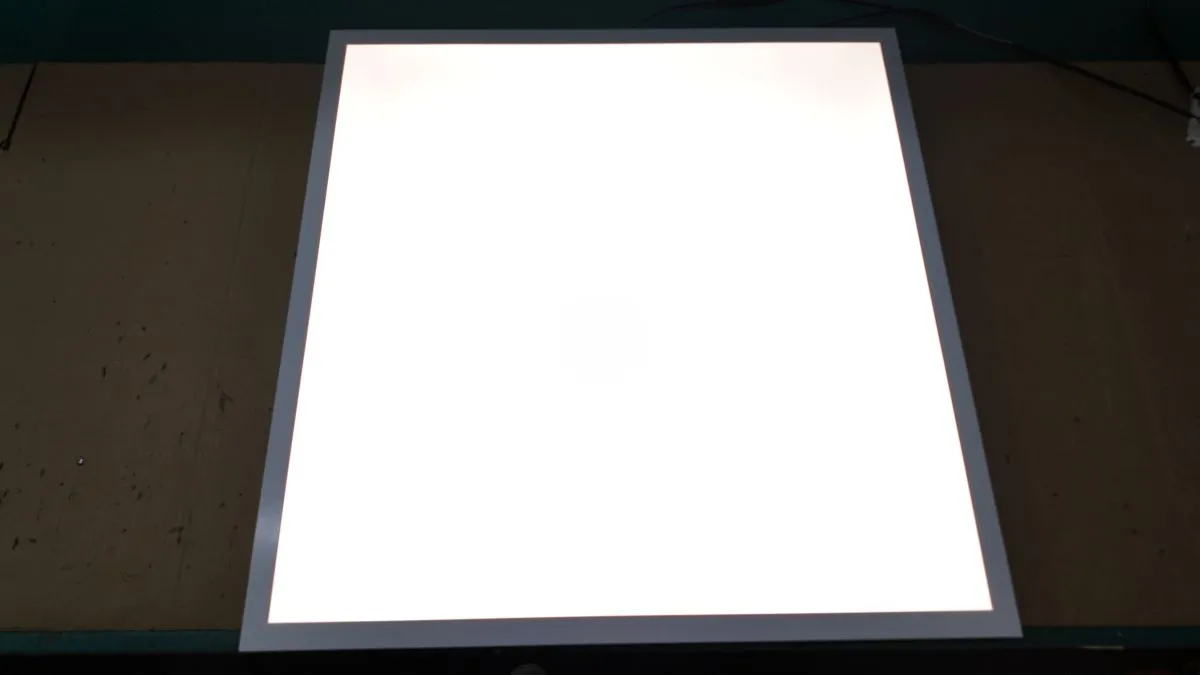
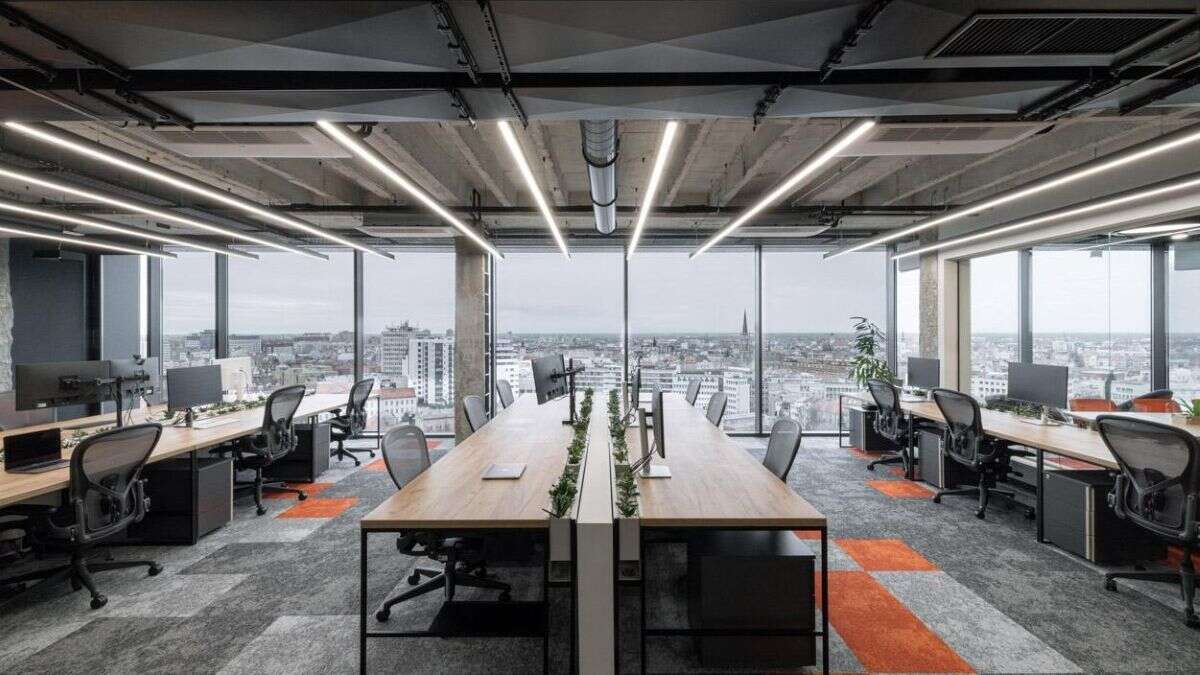
Commercial lighting is often selected too late, after the ceiling layout, interior design and electrical routes have already been fixed.
A fixture may look right in a product catalogue but not fit the ceiling system. A low-glare product may not perform as expected after installation. A driver may not support the required control system. A standard fixture may also leave gaps in a continuous architectural lighting layout.
Architectural LED lighting should therefore be treated as part of the building system, not simply as a lighting product.
The right solution needs to work with the ceiling, lighting task, optical requirements, controls, maintenance plan and overall interior design.
This guide explains how to approach architectural lighting for offices, retail spaces, schools, healthcare facilities, showrooms and other commercial interiors. It focuses on the practical decisions involved in selecting linear lighting, grille fixtures and track-based solutions.
What Does Architectural LED Lighting Mean?
Architectural LED lighting refers to LED fixtures and lighting systems selected and integrated around the architecture of a space.
The objective is not simply to produce enough light.
The fixture also needs to work with:
- Ceiling geometry
- Interior design
- Lighting tasks
- Glare requirements
- Colour appearance
- Lighting controls
- Installation conditions
- Maintenance requirements
- Project specifications
This is why architectural lighting can look very different from one project to another.
An open-plan office may require continuous recessed linear lighting with controlled glare. A showroom may combine track fixtures with linear ambient lighting. A school may prioritise uniform illumination and visual comfort, while a premium reception area may require a fixture that visually integrates into the ceiling.
In other words, the best architecture lights are not necessarily the most powerful fixtures.
They are the fixtures whose optical, mechanical and control characteristics match the room.
Before selecting a product, start with five questions:
- What type of ceiling will the fixture be installed into?
- What tasks will people perform under the lighting?
- Where are the main viewing directions and potential glare sources?
- What control system does the project require?
- Which dimensions, finishes and mounting details need to be customised?
Answering these questions early can prevent costly changes later.
Start With the Ceiling and Lighting Layout
The ceiling interface is one of the first engineering decisions in a commercial lighting project.
A concrete ceiling, exposed structure, T-grid ceiling and plasterboard ceiling do not provide the same fixing methods or service access.
A fixture that works well in one ceiling may require additional framing, cutting or access provisions in another.
For this reason, do not select an architectural LED fixture from its appearance alone.
Check the complete installation interface, inclusding:
- Ceiling grid or cut-out dimensions
- Fixture depth
- Driver location
- Cable entry position
- Mounting clips or brackets
- Continuous-run connections
- Emergency lighting requirements
- Future replacement access
This becomes particularly important with long continuous lighting layouts.
For recessed linear lighting, even a small mismatch between the fixture length and ceiling module can become visible after installation.
Choose the Fixture Type by Lighting Task
There is no single fixture type that works for every architectural space.
A better approach is to start with the lighting task and then select the fixture family.
Linear Lighting for Continuous Architectural Layouts
Linear lighting is well suited to projects where the lighting design is based on continuous lines, repeated modules or structured ceiling layouts.
It can be used in:
- Offices
- Corridors
- Reception areas
- Retail interiors
- Schools
- Commercial building
- Hospitality spaces

A well-designed linear system can also help maintain a consistent visual language across different ceiling conditions.
Depending on the project, the same general lighting concept may use surface-mounted, suspended or recessed fixtures.
For office applications, a UGR<16 LED linear light may be considered when the project has demanding glare-control requirements.
However, UGR should not be treated as a standalone product number. Actual glare depends on the luminaire, room geometry, observer position, mounting height and lighting layout.
The supplier should therefore provide appropriate photometric information and the conditions behind the claimed value.
Free Project Checklist
Planning an architectural LED lighting project?
Before requesting quotations, use this checklist to define fixture type, ceiling interface, glare requirements, controls, documentation and sample approval.
Download the free Architectural LED Lighting Project Checklist
Grille Lighting for Controlled Glare
Grille and louver fixtures are useful when the project requires controlled light distribution and a structured ceiling appearance.
A louver can reduce direct views of the LED source and help control the direction of emitted light.
OLAMLED’s LED louver and grille lighting range includes CA, CC and CF configurations with different optical designs, installation options and customisation possibilities.
For projects that require DALI-2 LED grille light solutions, the driver and control architecture should also be confirmed before product approval.

Track Lighting for Flexible Directional Light
Track lighting is useful when the position or direction of light may need to change during the life of a space.
A track system allows fixtures to be repositioned or aimed without redesigning the entire ceiling.
An LED track panel light can provide broader illumination than a small directional track head, while track linear systems can introduce a more continuous architectural line.
Track compatibility should always be confirmed against the actual track system.
Do not rely only on a product description that says “universal track.”
Glare: Look Beyond the UGR Number
Glare is one of the most common reasons why an otherwise technically adequate lighting installation may feel uncomfortable.
UGR, or Unified Glare Rating, is an established method for evaluating discomfort glare in interior lighting. The CIE describes UGR as a calculation that considers factors including luminaire luminance, background luminance, observer position and the geometry of the installation. (CIE)
This means a UGR value does not exist independently of the room.
The IES also treats glare, illuminance, colour, controls, maintenance and luminaire selection as connected elements of office lighting design.
So instead of asking only:
“Is this fixture UGR<19?”
ask:
“Under what installation conditions was this UGR value obtained?”
That is a much more useful question for an engineering project.

CRI, CCT and Visual Appearance
Architectural lighting is also about how people see the space and the objects within it.
CRI becomes particularly important where colour recognition matters.
CCT should also be selected according to the application.
Warm white may be appropriate for hospitality and decorative environments, while neutral white is commonly used in offices, schools, retail and healthcare.
There is no universal “best” colour temperature.
The right choice depends on the interior, task and project brief.
For projects using multiple fixture types, colour consistency is also important.
For example, if a project combines linear lighting, grille fixtures and track lighting in the same visible space, their CCT and colour-rendering characteristics should be coordinated.
Lighting Controls Should Be Specified Early
Lighting controls are increasingly important in commercial projects.
A simple installation may only require on/off switching.
More advanced projects may require:
- 1–10V dimming
- DALI-2
- D4i
- Occupancy sensors
- Daylight sensors
- Emergency lighting
- Building-management integration
DALI-2 is a standardised digital lighting-control approach. The DALI Alliance explains that DALI-2 includes standardised control devices and focuses on multi-vendor interoperability. (Dali Alliance)
For project buyers, the important point is to define the control architecture before the final fixture is approved.
If a project requires DALI-2, confirm:
- The exact driver model
- Required DALI functionality
- Certification or product evidence
- Sensor compatibility
- Emergency compatibility
- Wiring requirements
- Commissioning requirements
A product page saying “DALI compatible” should not be treated as complete technical evidence.
When Does Customisation Make Sense?

Standard products are efficient when the project fits the standard configuration.
Customisation becomes valuable when the building does not.
For example, a recessed linear light office layout may require a specific fixture length to align with ceiling modules, partitions or architectural lines.
Changing the fixture length may be more practical than changing the ceiling design.
This is where an experienced LED linear light manufacturer can provide more value than a catalogue-only supplier.
The supplier should be able to review drawings, confirm mechanical interfaces, prepare samples, provide photometric information and support the transition from prototype to production.

Build a Lighting Schedule That Engineers Can Actually Use
A lighting schedule should make technical comparison straightforward.
Instead of specifying only:
LED linear light
define the characteristics that affect installation and procurement.
| Item | What to Specify |
| Fixture type | Linear, grille, track panel, track linear |
| Installation | Recessed, surface, suspended, track |
| Dimensions | Standard or custom |
| Output | Target lumens |
| Efficacy | Required lm/W |
| Glare | UGR target and calculation basis |
| Colour | CCT and CRI |
| Driver | Brand, function and dimming protocol |
| Controls | DALI-2, 1–10V, sensors, emergency |
| Finish | Housing and reflector colour |
| Certification | Market-specific requirements |
| Documentation | Datasheet, IES/LDT, test reports |
| Sample | Golden sample approval |
| Warranty | Project requirement |
This turns a product search into an engineering specification.
A Practical Selection Matrix
Use the following matrix as an initial screening tool when comparing architectural LED fixtures.
| Project Requirement | Linear Lighting | Grille Lighting | Track Lighting |
| Continuous architectural lines | Strong fit | Moderate | Strong with track linear |
| Low-glare office lighting | Strong with suitable optics | Strong | Depends on fixture |
| Flexible aiming | Limited | Limited | Strong |
| Recessed ceiling integration | Strong | Strong | Depends on system |
| Retail display flexibility | Moderate | Moderate | Strong |
| Custom lengths | Strong | Available on selected models | More limited |
| Easy future repositioning | Moderate | Low | Strong |
This table should not replace lighting calculations.
Its purpose is to help the project team narrow down the appropriate fixture family before detailed specification.
Procurement Checklist for Architectural LED Lighting
Before approving a commercial architectural LED fixture, ask the supplier to provide:
- Exact model number and revision
- Technical datasheet
- Photometric IES or LDT file
- UGR information and calculation conditions
- Driver model and control protocol
- CCT and CRI data
- Dimensions and mounting details
- Installation drawing
- Certification documents for the target market
- Warranty terms
- Sample or golden sample process
- Production quality-control information
For EU projects, also check the applicable product requirements for the specific lighting product. The European Commission explains that ecodesign requirements apply to lighting products within scope, while energy-labelling requirements apply to certain light sources rather than luminaires generally. (Energy Efficient Products)

FAQ: Architectural LED Lighting
What is architectural LED lighting?
Architectural LED lighting is the use of LED luminaires selected and integrated according to a building’s architecture, ceiling system, lighting tasks, visual requirements and controls.
It can include linear, recessed, grille, track and other commercial lighting systems.
What are architecture lights used for?
Architecture lights are commonly used in offices, retail stores, schools, hospitals, hospitality spaces, showrooms, galleries and other commercial interiors where lighting needs to work with the overall building design.
Is UGR<16 always better than UGR<19?
Not automatically.
A lower UGR value indicates lower discomfort glare under the stated evaluation conditions, but actual performance depends on room geometry, luminaire position, observer position, surface reflectances and installation layout.
The target should therefore be based on the project requirement rather than choosing the lowest number available.
When should I choose linear lighting instead of track lighting?
Linear lighting is generally suitable when the design requires continuous lines, repeated modules or structured general illumination.
Track lighting is more useful when the direction or position of the light may need to change.
Some commercial projects use both systems.
Can architectural LED lighting be customised?
Yes.
Depending on the manufacturer and product family, customisation can include dimensions, wattage, CCT, CRI, optics, drivers, controls, housing finishes, mounting methods and emergency functions.
The feasibility should be confirmed against the actual project drawings.
How to Specify Architectural LED Lighting
Architectural LED lighting works best when it is specified as part of the building rather than selected as an isolated fixture.
Start with the ceiling and lighting task.
Then evaluate:
Optics → glare → colour → controls → installation → maintenance → documentation.
Once these requirements are clear, the choice between linear lighting, grille fixtures, track systems or a combination becomes much easier.
For projects requiring non-standard dimensions, specific controls, special finishes or coordinated fixture families, a manufacturer with in-house engineering and custom-production capability can help bridge the gap between the lighting concept and the finished product.
OLAMLED provides commercial LED lighting across linear, grille, panel, track and other fixture categories, with engineering support for project-specific requirements.
If you already have a ceiling plan, lighting schedule, BOQ or reference fixture, send the project requirements for technical review and a customised quotation.