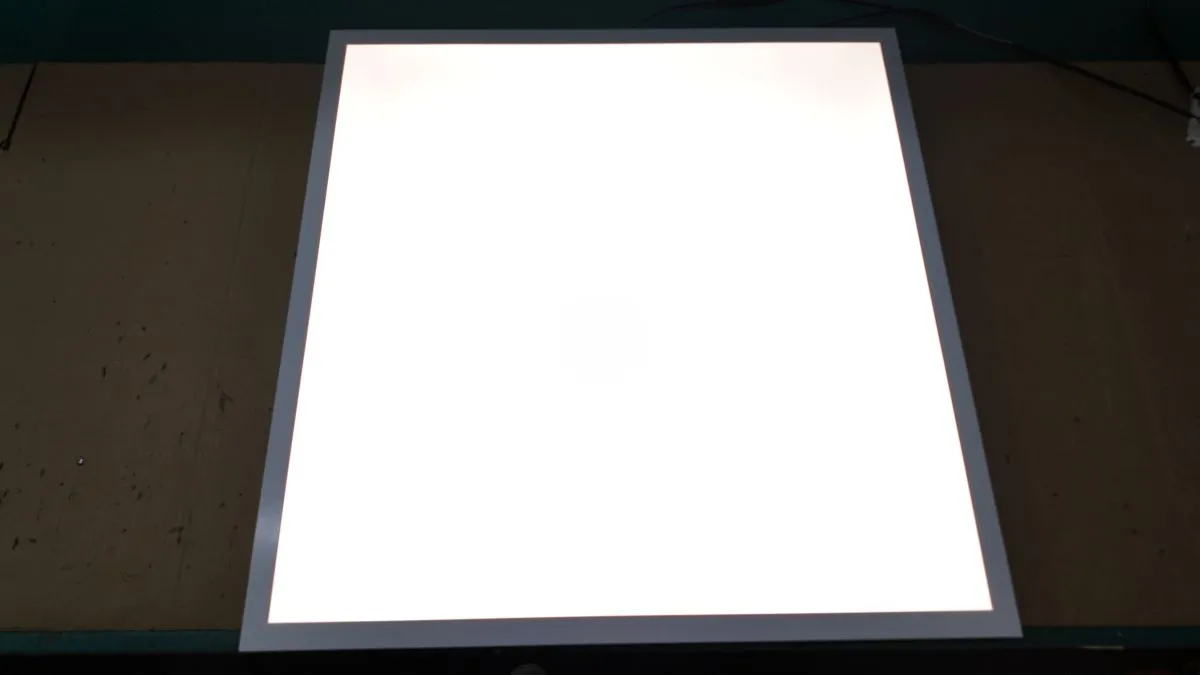
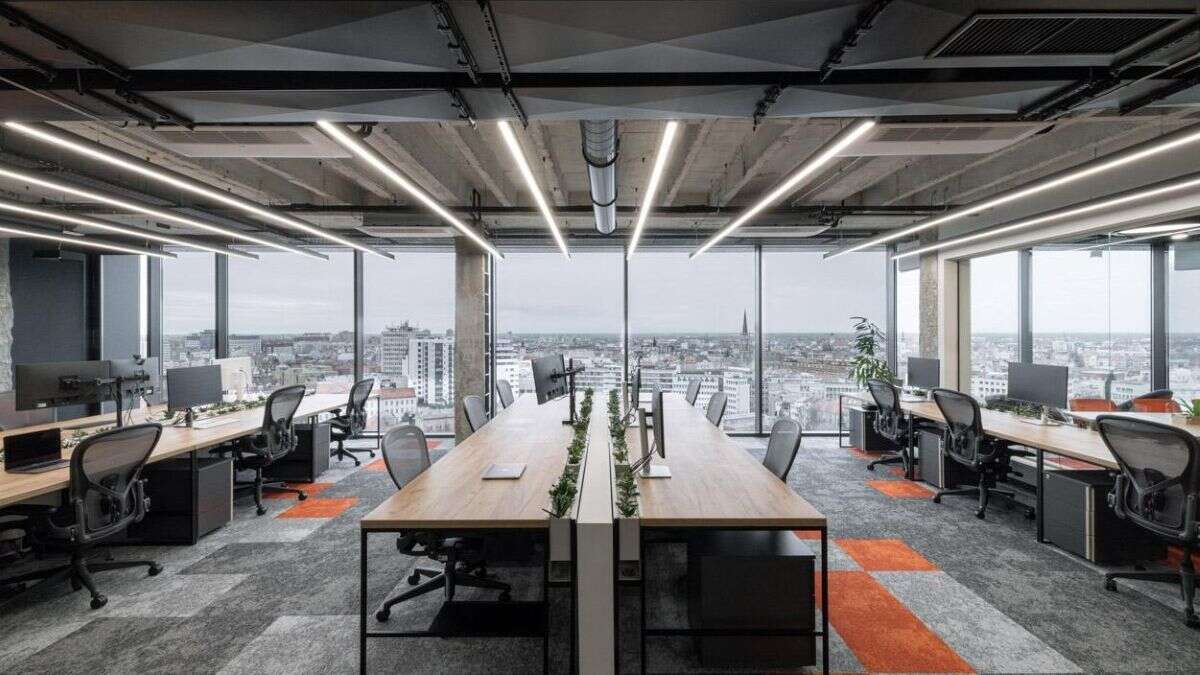
When a commercial lighting project is specified, buyers usually focus on lumen output, efficacy, CRI, CCT, UGR and price.
Flicker is often left until the end.
That can create problems during sampling, dimming tests or project handover.
A fixture may look perfectly steady during a quick visual inspection, yet its light output can still vary over time. For commercial projects, especially offices, schools, healthcare facilities and other spaces with long operating hours, flicker should be treated as part of the technical specification rather than a simple marketing claim.
This guide explains what commercial buyers should check when sourcing flicker free LED lighting, how drivers affect temporal light modulation, and how to verify non flickering LED lights before signing a purchase order.
What Does Flicker-Free LED Lighting Actually Mean?
The phrase flicker-free LED lighting is widely used by manufacturers, but it should not be treated as a specification by itself.
LED light output can change over time because of the way the LED driver regulates current. These changes may be visible in some situations and difficult to notice in others.
The European Ecodesign regulation provides two useful metrics for evaluating temporal light modulation:
- PstLM for flicker
- SVM for stroboscopic effects
Under the EU Ecodesign requirements for in-scope LED and OLED mains light sources, the full-load limits include PstLM ≤ 1.0 and SVM ≤ 0.4. The regulation also defines PstLM and SVM as the metrics used for flicker and stroboscopic effects respectively.
This matters because “flicker-free” should ideally be backed by measurable information.
For a commercial buyer, the better question is not:
“Is this LED light flicker-free?”
Instead, ask:
“What flicker and temporal-light-modulation data can you provide for this exact driver and luminaire configuration?”
That small change can make supplier evaluation much more useful.
Why Flicker Free Lighting Matters in Commercial Projects
Commercial lighting is rarely purchased as a single fixture.
A typical project may involve hundreds or thousands of luminaires operating for long periods. The selected driver, dimming method and control system therefore become part of the overall project specification.
Flicker can become particularly relevant when:
- LED panels are used throughout an office floor
- lighting is combined with cameras or video equipment
- luminaires are dimmed rather than operated only at full load
- different driver brands are used across the same project
- lighting is installed in schools or healthcare environments
- the project requires documented technical performance
- a distributor needs a repeatable product specification
This is why flicker free lighting should be considered together with the driver, control protocol and intended operating condition.
It is not simply an LED-chip specification.

Flicker-Free LED Lights Start With the Driver
One of the most important points for buyers is that the LED chip alone does not determine the final flicker performance of a luminaire.
The driver controls how electrical power is delivered to the LED system. Driver design, current regulation and dimming method can therefore influence temporal light output.
For procurement, it is useful to evaluate the complete combination:
LED source + driver + dimming method + control system
rather than selecting an LED module independently from the driver.
For example, a project specification may require:
- fixed-output operation
- 1–10V dimming
- DALI-2 dimming
- emergency operation
- sensor control
- tunable CCT
Each configuration should be checked for compatibility.
OLAMLED’s commercial lighting range supports different control and driver configurations, including 1–10V, DALI-2, D4i and other control options depending on the product family. Its customization process also allows the electrical and structural configuration to be developed around the project requirement.
For buyers, this means the driver should be written into the RFQ instead of simply asking for a “dimmable LED panel.”
Are Dimmable LED Lights Always Flicker-Free?
No. “Dimmable” and “flicker-free” describe two fundamentally different electrical characteristics.
A driver may successfully support light dimming while still introducing severe temporal light modulation (TLM) at lower brightness levels. In fact, many flicker complaints in commercial projects do not appear during initial full-load testing—they only surface after the luminaires are connected to a dimming system and dropped to 10% or 1% output.
This makes dimming compatibility a critical specification point, particularly when using:
- 1–10V / 0–10V analog dimming
- DALI / DALI-2 digital protocols
- Phase-cut (TRIAC / ELV) dimmers
- Pulse-Width Modulation (PWM) drivers
- Wireless and smart control systems
Because dimming methods directly alter how current is delivered to the LED engine, the control protocol and dimming range must be specified together with the exact driver model rather than added as an afterthought.
How to Specify Dimmable & Flicker-Free Lighting in an RFQ
Instead of adding “flicker-free” to the end of a generic product description, specify the entire electrical control package in your Request for Quotation (RFQ).
❌ Not Ideal:
“Dimmable 600×600 LED panel light, flicker-free.”
✅ Stronger RFQ Wording:
“Commercial LED panel light with DALI-2 driver (specified model), 1%–100% dimming range, and documented $P_{st}^{LM} \le 1.0$ and $SVM \le 0.4$ test data across the full dimming curve.”
To make supplier evaluation clear and repeatable, use a structured specification breakdown in your procurement document:
| Parameter | What to Specify in RFQ |
| Driver Engine | Exact manufacturer and model SKU (or approved equivalent) |
| Control Protocol | Fixed-output, 1–10V, DALI-2, D4i, or wireless system |
| Dimming Range | Required minimum dimming level (e.g., 10%, 1%, or 0.1%) |
| Flicker Metrics | Documented $P_{st}^{LM}$ and $SVM$ test reports at 100% and minimum load |
| Optical & CCT | Lens/diffuser type, fixed or tunable CCT, and minimum CRI |
| Compliance Docs | Complete luminaire datasheet, driver datasheet, and IES/LDT files |
Specifying both the dimming protocol and temporal light requirements up front ensures suppliers provide comparable technical quotes and that test samples accurately mirror mass-production units.
What Should Commercial Buyers Put in an LED Lighting RFQ?
For distributors and project buyers, a good RFQ should describe the actual application rather than only the product name.
For example, instead of:
600×600 flicker-free LED panel
a stronger specification would describe:
Commercial LED panel light for office application, recessed installation, specified CCT and CRI, required glare level, approved driver protocol, documented flicker performance, photometric file and production sample for approval.
The same principle applies to linear lighting, grille lights and other commercial LED fixtures.
OLAMLED’s current commercial lighting offering covers panel, linear, grille, track and other fixture types, with customization available for dimensions, structures, controls and other project requirements.
For distributors, this also makes it easier to maintain a consistent SKU specification across different orders.
Don’t Treat Flicker as a Standalone Specification
A common procurement mistake is to evaluate flicker separately from the rest of the lighting system.
In reality, several parameters need to work together.
Driver
The driver determines how power is delivered to the LED system.
Dimming
The control method can change operating conditions and therefore needs compatibility testing.
Optics
A good driver does not compensate for an unsuitable optical design.
Glare
Flicker and glare are different issues. A project can require both low glare and controlled temporal light modulation.
Photometrics
The approved luminaire should also meet the required light distribution, illuminance and uniformity.
Installation
Ceiling type, mounting height and room geometry affect the final lighting result.
This is why commercial lighting procurement should look at the complete luminaire rather than selecting components independently.
For projects involving office lighting, OLAMLED’s office lighting range combines panel and linear solutions with different glare, control, mounting and customization options.
How Flicker-Free LED Lighting Fits Into Office and Commercial Projects
Office lighting is a good example of why these specifications need to work together.
An office project may require:
- consistent illumination across workstations
- controlled glare
- suitable CRI
- a specific CCT
- dimming
- occupancy or daylight controls
- compatibility with the building control system
- documented technical data
Flicker is therefore only one part of the specification.
The same applies to schools, healthcare facilities, retail environments and other commercial spaces.
For example, OLAMLED’s current office lighting information covers panel formats, UGR options, DALI-2 and other controls, as well as recessed, surface-mounted and suspended installation.
The exact specification should still be confirmed against the project design and applicable local requirements.
A Step-by-Step Supplier Evaluation & Documentation Checklist
Claiming “flicker-free” on a product catalog is easy; verifying it for a commercial procurement project requires a structured verification process.
To prevent costly component swaps, dimming issues, or project handover failures, buyers should evaluate suppliers using this consolidated 5-step framework—combining practical inspection steps, required technical documentation, and a final evaluation checklist.

Step-by-Step Verification Framework & Required Documentation
1. Pin Down the Exact Driver Model
The LED chip alone does not determine flicker performance—the driver regulates current and directly dictates temporal light modulation.
Action: Do not accept just a driver brand name. Require the specific model SKU to be defined in writing.
Documents to Request:
Complete Luminaire Datasheet
Official Driver Datasheet (specifying input/output voltage, output current, and dimming protocol)
2. Request Verifiable Temporal Light Modulation (TLM) Data
Under EU Ecodesign regulations, marketing claims must be backed by standardized metrics: $P_{st}^{LM} \le 1.0$ for flicker and $SVM \le 0.4$ for stroboscopic effects.
Action: Ask for test reports conducted on the exact luminaire and driver combination being purchased.
Documents to Request:
Photometric Test Reports ($P_{st}^{LM}$ and $SVM$ metrics)
IES / LDT Photometric Files
UGR Calculation Reports (with stated room reflectivity and installation conditions)
3. Test Physical Samples Under Real Operating Conditions
A fixture that runs smoothly at 100% load may exhibit severe flicker when dimmed to 10% or connected to a central control system.
Action: Request a golden sample built with the exact LED module, driver model, optic, and control module intended for mass production. Test it across the full dimming range (1%–100%).
Documents to Request:
Sample Approval Form (Signed configuration sheet)
Dimming & Control System Compatibility Statement (DALI-2, 1–10V, TRIAC, etc.)
4. Verify Certification & Compliance
Ensure the luminaire configuration satisfies both electrical safety and regional efficiency codes.
Action: Validate that test certificates match the specific driver model and factory site.
Documents to Request:
CE / RoHS / EMC Compliance Certificates
Production Quality Inspection (QC) Guidelines
5. Lock the Approved Configuration in the Purchase Order
Prevent unannounced sub-component substitutions during mass production.
Action: Write the full component breakdown into the binding Purchase Order (PO): Fixture Housing + LED Light Engine SKU + Driver Model SKU + Control Protocol + Optical Diffuser
Free Download: Commercial Flicker-Free LED Lighting Buyer’s Checklist
Comparing LED lighting suppliers?
Download our practical checklist covering:
- Driver information to request
- PstLM and SVM data
- Dimming compatibility
- Sample approval
- Photometric files
- RFQ wording
- Production consistency
- Final inspection
Use the checklist before approving your next LED lighting sample.
How to Compare Two Flicker-Free LED Suppliers
Suppose two suppliers both advertise flicker free LED products.
Supplier A provides:
Flicker-free LED panel, high efficiency, premium driver.
Supplier B provides:
LED panel with specified driver model, documented PstLM/SVM data, IES file, UGR information, dimming compatibility and approved production sample.
The second quotation gives the buyer more information to evaluate.
This does not automatically mean the second product is better. It means the performance claim is easier to verify.
For commercial procurement, verifiable specifications are more useful than marketing language.
That principle can also be applied to efficacy, CRI, lifetime, UGR and control compatibility.

Choosing a Flicker-Free LED Lighting Supplier
For a commercial project, supplier capability goes beyond having a product labelled “flicker-free.”
A useful supplier should be able to discuss:
- LED source selection
- driver matching
- optical design
- dimming compatibility
- thermal management
- photometric testing
- product customization
- sample approval
- production consistency
- technical documentation
This becomes even more important when the project requires custom dimensions, specific ceiling grids, special CCT, different CRI levels or a particular control system.
OLAMLED positions its commercial lighting manufacturing around deep customization, engineering support and in-house development. Its current customization process covers structural dimensions, installation requirements, control functions, product appearance and other project-specific requirements.
For buyers working on a custom panel project, the relevant starting point is the Custom LED Panel Solutions Playbook, which covers requirements capture, optical strategy, controls, prototype verification and procurement documentation.
For distributors and private-label buyers, the OEM LED Panel Light Buying Guide is more relevant because it focuses on RFQ decisions, driver protocols, grid dimensions, documentation and sample approval.

FAQ
Are all LED lights flicker-free?
No. LED lighting systems can have different temporal light modulation characteristics depending on the LED source, driver and operating condition. Buyers should request technical evidence rather than assuming every LED fixture is flicker-free.
What are no-flicker LED lights?
“No-flicker LED lights” is a common search term for LED products designed to minimize temporal fluctuations in light output. For commercial procurement, it is better to evaluate the actual driver, test conditions and available flicker-related data.
How do you test flicker-free LED lights?
Testing can involve measuring the temporal light output and calculating metrics such as PstLM and SVM. For an EU project, buyers should confirm which measurement method and test conditions apply to the product being specified. The EU Ecodesign regulation defines PstLM and SVM as the relevant metrics for flicker and stroboscopic effects.
Are dimmable LED lights always flicker-free?
No. Dimming compatibility and flicker performance are separate considerations. The driver and control protocol should be tested together, particularly when the project uses low dimming levels or a specific control system.
What should I ask an LED manufacturer about flicker?
Ask for the exact driver model, flicker-related test data, operating conditions, dimming compatibility and confirmation that the tested configuration matches the production configuration.
Does flicker-free mean low glare?
No. Flicker and glare are different lighting characteristics. A commercial luminaire may need both controlled temporal light modulation and an appropriate UGR performance for the application.
What should be included in a commercial LED lighting RFQ?
At minimum, specify the luminaire type, dimensions, CCT, CRI, optical requirements, driver, dimming protocol, installation method, photometric documentation and required flicker-related evidence.
How do you verify non flickering LED lights during sample testing?
To verify non flickering LED lights, test the complete fixture using the actual driver across 100%, 50%, and 1% dimming levels using a calibrated spectrometer to measure $P_{st}^{LM}$ and $SVM$ metrics.
Next Steps for Your Project
For commercial lighting, flicker free LED lighting should be treated as a specification that can be checked, not simply a phrase on a product page.
Start with the complete system:
LED source → Driver → Dimming → Control → Optical design → Testing → Documentation
For procurement teams, the most useful approach is to define the requirement before requesting quotations, approve the actual driver and luminaire combination during sampling, and keep the approved configuration as the production reference.
That makes it easier to compare suppliers, reduce specification gaps and maintain consistency from sample to mass production.
If your project has specific requirements for LED panels, linear lighting or other commercial fixtures, OLAMLED can work from the project specification and develop the required configuration rather than limiting the project to a fixed catalogue model.