3000K is the better choice for rooms you relax in — bedrooms, living rooms and dining rooms — while 4000K is the better choice for rooms you work in — kitchens, bathrooms, home offices, laundries and garages. The two color temperatures differ only in the color of the white light they emit, not in how much light they produce.
3000K light is a warm, slightly yellow white that mimics a halogen lamp. 4000K light is a neutral, paper-white that sits halfway between halogen and daylight. Choosing between them is a decision about the task performed in the room and the time of day the room is used, not a decision about brightness or energy cost. This guide gives you the room-by-room answer first, then explains the physics, the specifications and the mixing rules behind it.
| Room | Recommended CCT | Reason |
|---|---|---|
| Bedroom | 2700K–3000K | Low short-wavelength content supports evening wind-down |
| Living room | 3000K | Warm cast flatters skin tones, wood and textiles |
| Dining room | 2700K–3000K | Warm light renders food as appetizing |
| Kitchen worktop | 4000K | Neutral white separates ingredient colors accurately |
| Bathroom mirror | 4000K | Neutral white shows true skin and make-up color |
| Home office | 4000K | Neutral white sustains alertness during work hours |
| Garage / workshop | 4000K–5000K | Cooler light aids detail and contrast on tools and parts |
| Hallway / stairs | 3000K | Matches the warm rooms it connects |
| Covered patio | 2700K–3000K | Warm light attracts fewer flying insects |
What Is Color Temperature, and Why Is It Measured in Kelvin?
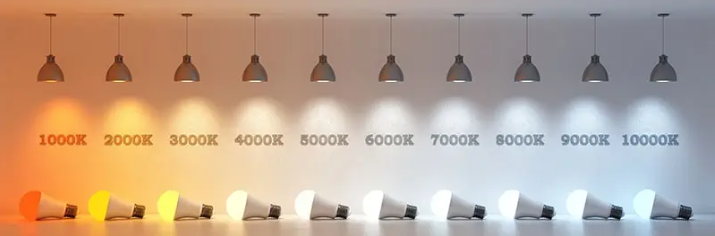
Correlated color temperature (CCT) is a specification that describes the color appearance of white light by naming the temperature, in kelvin (K), at which a theoretical black body radiator would glow that same color. A candle flame glows at roughly 1800K, a halogen lamp at roughly 2800K, and overcast midday sky at roughly 6500K. Because the scale is borrowed from an object being heated, it runs counter to everyday language: low kelvin numbers produce warm, yellow-red light and high kelvin numbers produce cool, blue-white light.
An LED does not glow because it is hot, so its color is matched to the black body curve rather than measured from it — which is why the specification is called correlated color temperature. The ANSI C78.377 standard defines what a manufacturer may legally print on the box: a lamp labeled 3000K must measure 3045K ± 175K, and a lamp labeled 4000K must measure 3985K ± 275K. Two fixtures from different brands can therefore both say “4000K” and still look visibly different on the ceiling.
| Band | Nominal CCT | Appearance | Familiar reference |
|---|---|---|---|
| Very warm white | 2200K–2700K | Amber | Filament bulb, candlelight |
| Warm white | 3000K | Yellowish white | Halogen downlight |
| Neutral white | 3500K–4000K | Paper white | Retail and office lighting |
| Cool white | 5000K | Blue-tinged white | Workshop, garage |
| Daylight | 6000K–6500K | Blue white | Overcast midday sky |
If the vocabulary around lumens, watts and kelvin is still blurry, our reference on lumens, wattage and color temperature defines each term before you compare products. So what does 3000K actually look like once it is on the ceiling?
What Is 3000K Light?
3000K light is a warm white light source whose spectral output is weighted toward the yellow and red end of the visible spectrum, producing a soft golden-white cast almost identical to a traditional halogen lamp. It is the warmest color temperature still widely considered a “white” light rather than an accent or decorative color.
| Attribute | Value for 3000K |
|---|---|
| ANSI nominal range | 2870K–3220K |
| Visual character | Warm, yellowish white |
| Closest legacy source | Halogen lamp (~2900K) |
| Short-wavelength (blue) content | Low |
| Effect on warm materials | Enhances oak, walnut, terracotta, brass, warm textiles |
| Effect on cool materials | Dulls grays, whites and blues slightly |
| Typical residential use | Bedroom, living room, dining room, hallway, hospitality |
Where 3000K Works Best at Home
3000K works best in every room whose primary job is rest, conversation or hospitality. Its low blue content makes it the correct evening light for a bedroom, and its warm cast is what makes a living room read as comfortable rather than clinical. The same reasoning explains why restaurants, cafés, hotel lobbies and spas specify 3000K almost universally: the color temperature signals relaxation before a guest consciously registers it.
- Bedrooms — warm light in the two hours before sleep suppresses melatonin less than neutral or cool light.
- Living and dining rooms — 3000K renders skin tones and food warmly and flatters wood finishes.
- Accent and decorative lighting — table lamps, cove lighting, wall washers and picture lights.
- Hospitality-style spaces at home — home bars, media rooms, reading nooks.
Where 3000K Falls Short
3000K falls short wherever color accuracy decides an outcome. Under a warm cast, raw chicken looks slightly cooked, a bruise on fruit is harder to see, foundation applied at the mirror reads several shades warmer than it will in daylight, and cool grays in a paint sample look muddy. In a north-facing room that already receives cool daylight, 3000K downlights also create a visible color clash along the boundary between the two light sources.

What Is 4000K Light?
4000K light is a neutral white light source with a balanced spectral output that shows colors close to the way natural daylight shows them, without the yellow cast of 3000K or the blue cast of 5000K. It is the default color temperature for task lighting because it separates similar colors — two shades of red, two shades of blue — more clearly than warm white does.
| Attribute | Value for 4000K |
|---|---|
| ANSI nominal range | 3710K–4260K |
| Visual character | Neutral, paper white |
| Closest legacy source | Cool white fluorescent tube |
| Short-wavelength (blue) content | Moderate |
| Effect on warm materials | Neutral — wood reads as its true tone, not amplified |
| Effect on cool materials | Keeps whites white and grays clean |
| Typical residential use | Kitchen, bathroom, home office, laundry, stairs, garage |
Where 4000K Works Best at Home
4000K works best above any surface where you use your hands and need to judge color correctly. A kitchen worktop, a bathroom vanity, a desk, an ironing board and a workbench all qualify. Its moderate short-wavelength content also sustains alertness, which is why the same color temperature dominates LED office lighting and why a home office lit at 3000K often feels sleepy by mid-afternoon.
- Kitchens — chopping, checking doneness, distinguishing herbs and spices.
- Bathrooms — shaving, make-up application, checking skin.
- Home offices and study areas — reading, screen work, video calls.
- Utility spaces — laundry, pantry, garage, basement and stairwells.
- Covered outdoor work areas — carports and workshops, where clarity outranks ambiance.
Where 4000K Falls Short
4000K falls short in the evening and in rooms designed around comfort. Its higher blue content is precisely what keeps you alert, so it is the wrong light for a bedroom after dark. It also strips warmth from timber floors, brick and warm-toned fabrics, which can make a carefully decorated living room look like a showroom. In small rooms with white walls, 4000K at high output can read as harsh — the fix is lower lumen output or dimming, not a warmer lamp.
3000K vs 4000K: Side-by-Side Comparison
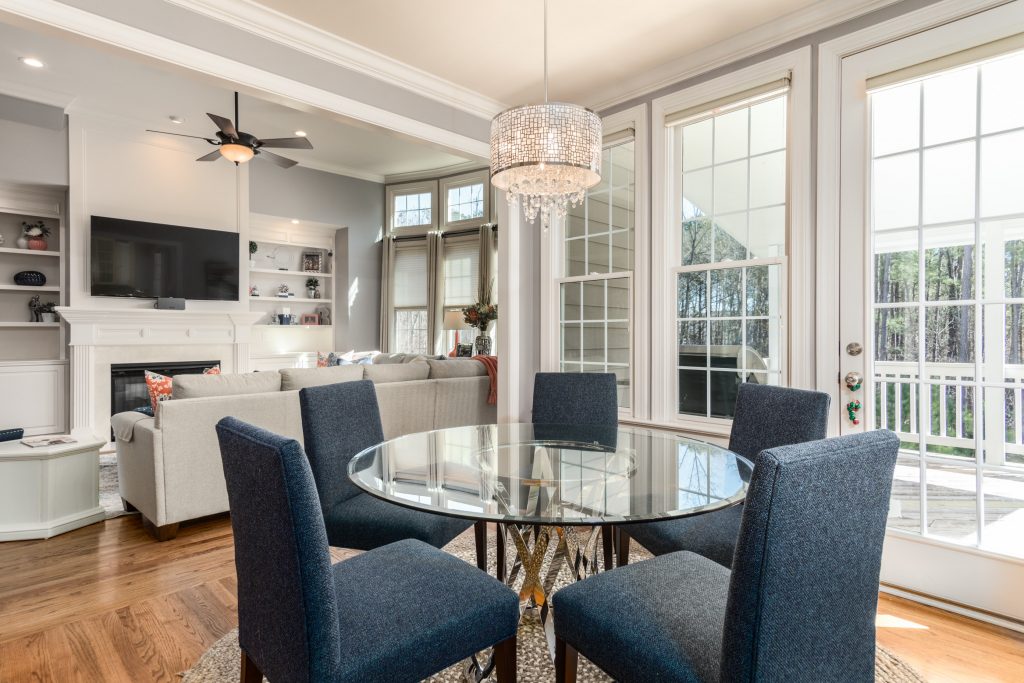
3000K and 4000K differ in five measurable ways — color appearance, color rendering behavior, perceived brightness, circadian effect and luminous efficacy — and are identical in three ways buyers often assume they differ: wattage, lifespan and dimmability. The table below separates the real differences from the imagined ones.
| Criterion | 3000K | 4000K |
|---|---|---|
| Color appearance | Warm, yellowish white | Neutral, paper white |
| Perceived atmosphere | Relaxing, intimate | Alert, clean, productive |
| Color discrimination | Good on warm hues, weaker on blues and grays | Balanced across the whole spectrum |
| Perceived brightness at equal lumens | Appears slightly dimmer | Appears slightly brighter |
| Circadian / alerting effect | Low — suitable after sunset | Moderate — best before evening |
| Luminous efficacy (lm/W) at equal CRI | Baseline | Typically a few percent higher |
| Energy consumed | Equal at equal wattage | Equal at equal wattage |
| Rated lifespan (L70) | Unaffected by CCT | Unaffected by CCT |
| Dimmability | Depends on driver, not CCT | Depends on driver, not CCT |
| Best-fit rooms | Bedroom, living, dining, hallway | Kitchen, bathroom, office, garage |
Does 4000K Use More Energy Than 3000K?
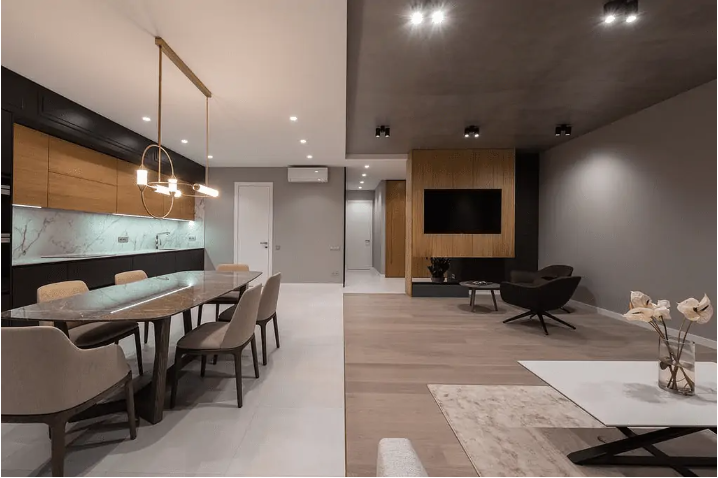
No. Color temperature has no effect on energy consumption. Energy use is set by the wattage printed on the fixture, and a 10W 3000K downlight and a 10W 4000K downlight draw exactly the same 10 watts and cost exactly the same to run.
If anything, the small technical advantage runs the other way. An LED produces white light by passing blue emitter light through a phosphor coating, and converting blue photons into red ones wastes more energy than converting them into yellow-green ones. A warmer LED needs a thicker, more red-heavy phosphor, so at the same color rendering index a 4000K package typically delivers a few percent more lumens per watt than a 3000K package of the same generation. The practical consequence for a home is close to zero — a handful of kilowatt-hours a year across an entire house — so choose your color temperature on how the room should look and feel, never on the electricity bill.
If running cost genuinely is the priority, the levers that matter are lumen output, control strategy and fixture efficacy — the same levers used in commercial projects, explained in our guides to occupancy-sensor control and dimming compatibility. That leaves one more myth worth clearing up: does a higher kelvin number mean brighter light?
Is 4000K Brighter Than 3000K? Is 5000K Brighter Than 3000K?
No — kelvin does not measure brightness. Lumens measure brightness. An 800-lumen 3000K bulb and an 800-lumen 5000K bulb emit exactly the same quantity of light; only the color differs. A 400-lumen 5000K bulb is genuinely dimmer than an 800-lumen 3000K bulb, no matter how high its kelvin number is.
The confusion is real, though, because cooler light looks brighter at identical lumen output. Human vision is more sensitive to the short and mid wavelengths that dominate cool white, and at low light levels the eye shifts further toward blue sensitivity still. That perceptual effect is why a 4000K garage feels crisper than a 3000K garage at the same measured lux, and why manufacturers of cheap fixtures push high kelvin numbers instead of high lumen output.
- To make a room brighter, raise the lumens or add fixtures — do not raise the kelvin.
- To change the mood of a room, change the kelvin — do not change the lumens.
- To judge a product, read lumens, watts, CCT and CRI together; a single number tells you nothing.
How Do You Choose Between 3000K and 4000K?
Choose by working through five questions in order, stopping at the first one that gives a clear answer. The method takes about a minute per room and produces a consistent whole-house scheme rather than a set of unrelated decisions.
- What is the primary task? Hands-on, colour-critical work → 4000K. Rest, conversation or eating → 3000K.
- When is the room used? Mainly after sunset → 3000K. Mainly during working hours → 4000K.
- What daylight does the room already get? A north-facing room receives cool daylight and pairs cleanly with 4000K; a south-facing room with warm afternoon light pairs better with 3000K.
- What are the dominant finishes? Oak, walnut, brass, terracotta and warm textiles → 3000K. White, gray, chrome, stone and glass → 4000K.
- What is next door? If the room is visible from an adjacent space, match that space unless a door separates them.
Where a single room genuinely needs both — an open-plan kitchen that becomes a dining space at night is the classic case — the answer is not a compromise at 3500K. It is a tunable-white fixture that shifts from 4000K for cooking to 3000K for dinner on one control, an approach borrowed directly from human-centric lighting design.
Room by Room: Should You Use 3000K or 4000K?
Is 3000K or 4000K Better for a Kitchen?
4000K is better for a kitchen, specifically over the worktop, hob and sink. Neutral white keeps the color of meat, fish, herbs and produce true, which matters when doneness and freshness are judged by eye. Target 300–500 lux on the worktop, delivered by under-cabinet linear fixtures rather than by ceiling lights alone, because a ceiling light behind you puts your own shadow on the chopping board.
In an open-plan kitchen that adjoins a dining table, run 4000K over the work zone and 3000K pendants over the table. The two zones are visually separated by function, so the color change reads as intentional rather than as a mistake.
Is 3000K or 4000K Better for a Bathroom?
4000K is better at the mirror, and 3000K is better everywhere else in the bathroom. Make-up and shaving need neutral light with a color rendering index of 90 or above so that skin tone matches what other people will see in daylight; a warm mirror light makes foundation read too orange outdoors. Ceiling and shower lighting can stay at 3000K if the bathroom doubles as a place to unwind, provided the two color temperatures are not visible in the same reflection.
Is 3000K or 4000K Better for a Bedroom?
3000K is better for a bedroom, and 2700K is better still for bedside lamps. Light with high short-wavelength content in the two hours before sleep delays melatonin release and pushes sleep onset later, so a bedroom is the one room where color temperature has a documented physiological consequence rather than an aesthetic one. Keep bedroom ambient light around 100–150 lux and put it on a dimmer.
Is 3000K or 4000K Better for a Living Room?
3000K is better for a living room in almost every case. The room’s job is comfort, its finishes are usually warm, and it is used mainly in the evening — all three of the decision questions point the same way. The exception is a living room that doubles as a daytime workspace, where a 4000K task lamp at the desk alongside 3000K ambient lighting serves both uses without repainting the whole room in neutral white.
Is 3000K or 4000K Better for a Home Office?
4000K is better for a home office. Aim for roughly 500 lux at the desk with a low-glare fixture positioned to the side of the screen rather than behind it, and add a dimmer so the room can drop to a warmer, lower level for evening use. Glare, not color temperature, is the most common cause of lighting-related eye strain, so check the fixture’s shielding before you change its kelvin rating.
Is 3000K or 4000K Better for a Garage or Workshop?
4000K is the minimum for a garage, and 5000K is defensible where fine detail work happens. Contrast and clarity outrank comfort in a space used for repairs, sorting and storage, and 300–750 lux is a realistic target depending on the task. Our guide to choosing LED garage lighting covers fixture layout and mounting height for these spaces.
Can You Mix 3000K and 4000K in the Same Home?
Yes — mix color temperatures between rooms, never within a single sightline. The eye adapts to one white point at a time, so two color temperatures visible together make the warmer one look dirty yellow and the cooler one look clinical blue. Once you walk through a doorway, adaptation resets and the change goes unnoticed.
- Safe to mix: a 3000K living room and a 4000K kitchen separated by a wall or a change in ceiling level.
- Safe to mix: 4000K worktop lighting and 3000K pendant lighting in one open-plan room, provided each has a clearly separate function and zone.
- Never mix: two color temperatures in one row of downlights, one bathroom mirror, or one continuous ceiling plane.
- Watch the binning: even fixtures with the same 4000K label can differ visibly. Specify a color consistency tolerance of 3-step MacAdam (SDCM) or tighter for any run of lights seen together.
The binning point is the one most homeowners discover too late. If you buy 3000K downlights from two different suppliers, or replace one failed unit two years later from a different batch, the mismatch will be obvious on a white ceiling — which is why color consistency is a specification line, not a detail.
Three Specifications That Matter as Much as Color Temperature
Color temperature decides how a room feels, but three other specifications decide whether the lighting actually works. Getting the kelvin right and these wrong produces a room that is the correct color and still unpleasant to be in.
- Color rendering index (CRI) and R9. CRI scores how faithfully a source reveals color, on a scale to 100. Specify CRI ≥ 90 with an R9 (deep red) value above 50 for kitchens, bathrooms and any room with skin tones or artwork; CRI ≥ 80 is adequate for garages and storage. The trade-offs between CRI and CCT are worth understanding before you choose either.
- Lumens and lux, not watts. Watts measure consumption; lumens measure output; lux measures what actually lands on the surface. Size fixtures from a lux target for the task, as explained in our breakdown of lumens versus wattage.
- Dimming and flicker. Dimmability is a property of the driver, not of the color temperature. A mismatched dimmer causes flicker, buzzing and a narrow dimming range — verify driver-to-dimmer compatibility before purchase.
Frequently Asked Questions About 3000K and 4000K
What is the actual difference between 3000K and 4000K?
The difference is color, not quantity. 3000K emits a warm yellowish white with more red and less blue in its spectrum; 4000K emits a neutral paper white with a balanced spectrum. Brightness, energy use and lifespan are unaffected by the difference.
Should I just use 3500K as a compromise?
Use 3500K only when one continuous space must serve both relaxation and task use and tunable-white fixtures are out of budget. 3500K is a genuine middle ground and reads cleanly, but it is neither as restful as 3000K nor as colour-accurate as 4000K, so it is a fallback rather than a first choice.
Is 2700K or 3000K better for a warm room?
2700K is warmer and closer to a filament bulb, making it the better match for period interiors, bedside lamps and dining pendants. 3000K is slightly cleaner and holds up better as general ambient light across a whole living area. Both sit in the warm white band and mix acceptably in adjacent rooms.
Which color temperature is better for resale value?
Warm white in living areas and neutral white in wet and work areas is the combination buyers respond to best, because it matches what they see in professionally styled properties. A whole house lit uniformly at 5000K is the single most common lighting complaint from prospective buyers.
Does 4000K lighting affect sleep?
4000K light can delay sleep onset when used at high levels in the two hours before bed, because its short-wavelength content suppresses melatonin more than warm white does. Intensity matters as much as color — a dimmed 4000K fixture at low output has far less effect than a bright one.
Is 3000K or 4000K better for outdoor lighting?
3000K or warmer is better for residential outdoor lighting. Warm light attracts fewer flying insects, causes less light pollution and looks more welcoming on a façade or patio. Reserve 4000K for security lighting, driveways and outdoor work areas where visibility is the goal.
Can I change the color temperature of a fixture I already own?
You can if the fixture has a CCT selector switch or a tunable-white driver; otherwise the color temperature is fixed at manufacture and the only option is replacement. Many modern downlights and panels include a 3000K/4000K/5000K selector on the housing, which is worth looking for when you are undecided.
Conclusion: Match the Kelvin to the Task, Not to the Trend
Use 3000K where people rest and 4000K where people work, keep one color temperature per sightline, and specify lumens, CRI and color consistency alongside the kelvin number. Those four rules resolve the overwhelming majority of residential lighting decisions without any further theory.
The two facts worth carrying away are the ones most often stated backwards: color temperature does not change how much electricity a fixture uses, and it does not change how much light a fixture produces. It changes how a room feels and how accurately colors appear — which is exactly why it deserves a deliberate decision rather than a default setting.
Sourcing 3000K and 4000K LED Fixtures from OLAMLED
OLAMLED is a Chinese LED lighting manufacturer with 17 years of production experience, supplying residential, commercial and project-scale fixtures in 3000K, 4000K and 5000K as standard, plus 2700K, 3500K, 6500K and tunable white on request. Every color temperature is available across the same product families, so a single project can run warm white in living areas and neutral white in work areas without changing supplier, housing or driver platform.
- Color consistency: fixtures are binned to 3-step MacAdam (SDCM) so that units installed in the same ceiling — and replacement units ordered later — match visually.
- Color rendering: CRI 80 as standard, with CRI 90+ and high-R9 options for kitchens, retail and healthcare applications.
- Tunable white: CCT-adjustable and dim-to-warm drivers for spaces that change function through the day.
- Customization: size, output, optics, finish, driver and packaging can all be specified — see our overview of LED customization options.
- Warranty: a 5-year warranty across the standard range.
Typical starting points by application: LED panel lights for flat ceilings and office-style spaces, LED linear lights for worktops, corridors and continuous runs, and LED track lights for accent and retail-style display lighting.
Request a Quote for Your Lighting Project
Tell us the rooms, the ceiling type and the color temperatures you need, and our engineering team will return a fixture schedule and a quotation. Send your requirements through the contact page, and include room dimensions, mounting height and any target lux levels if you have them — that is usually enough for us to specify the right wattage, optic and CCT combination first time.
Samples are available before bulk production so you can confirm the 3000K and 4000K appearance in your own space rather than on a screen — see how fast custom LED samples can be turned around.